
London tops the list of Europe’s richest cities by total output, but the story flips when you divide by population. Dublin suddenly leads, Frankfurt follows, and Berlin slides to the bottom. So which ranking tells the truth? Both do, in different ways. Below, we rank 25 cities by GDP and 25 by GDP per capita, then look at what actually drives the money in each place. Expect a few surprises. Expect some honest caveats about how these numbers get built, too.
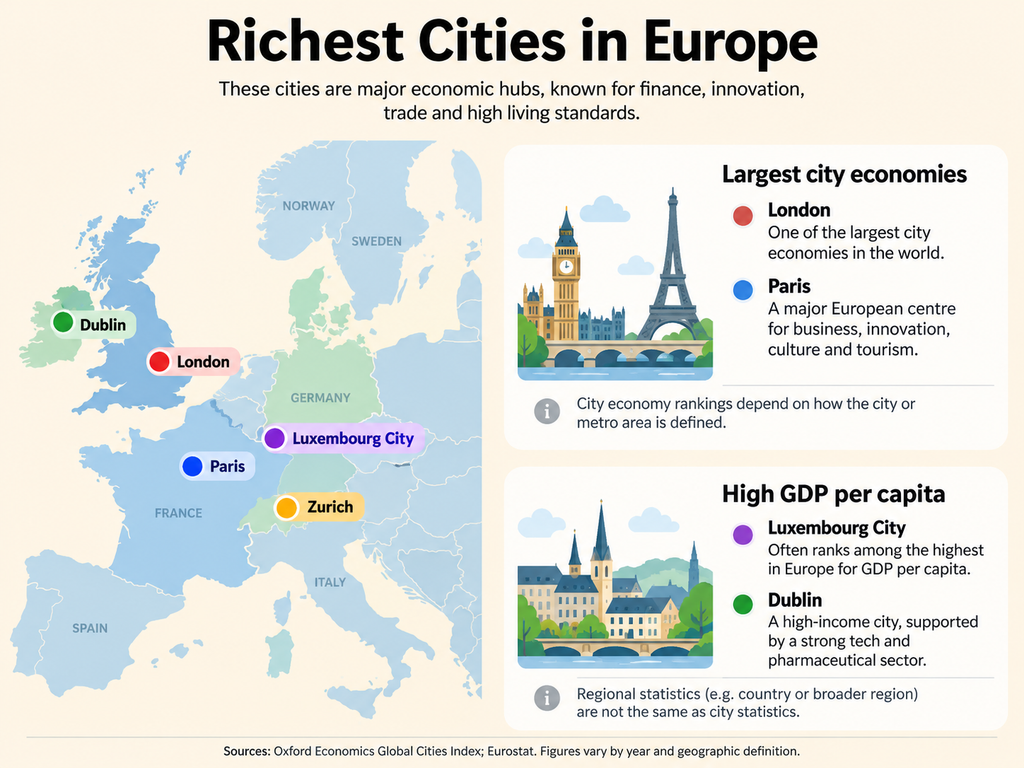
Richest Cities in Europe at a Glance
| Measure | Leader | Figure | Runner-up | Figure |
|---|---|---|---|---|
| Total GDP | London, UK | $879 billion | Paris, France | $850 billion |
| GDP per capita | Dublin, Ireland | $115,094 | Frankfurt, Germany | $102,941 |
| Lowest in per capita top 25 | Berlin, Germany | $28,529 | Budapest, Hungary | $30,460 |
Only a handful of cities show up in both rankings. Milan, Stockholm, Frankfurt, Vienna, Paris, and London are the usual suspects. For a quick sense of who ranks high on both counts, start there.
Richest Cities in Europe Ranked by GDP
Total GDP measures the size of the whole local economy. It rewards big, populous metros. A city can post a huge number simply because millions of people live there.
| Rank | City | Country | GDP (US$ Billion) |
|---|---|---|---|
| 1 | London | UK | 879 |
| 2 | Paris | France | 850 |
| 3 | Moscow | Russia | 553 |
| 4 | Rhine-Ruhr | Germany | 485 |
| 5 | Istanbul | Turkey | 348 |
| 6 | Rotterdam | Netherlands | 320 |
| 7 | Amsterdam | Netherlands | 320 |
| 8 | Milan | Italy | 312 |
| 9 | Madrid | Spain | 262 |
| 10 | Brussels | Belgium | 254 |
| 11 | Frankfurt | Germany | 230 |
| 12 | Munich | Germany | 219 |
| 13 | Vienna | Austria | 183 |
| 14 | Barcelona | Spain | 171 |
| 15 | Rome | Italy | 163 |
| 16 | Hamburg | Germany | 161 |
| 17 | Stuttgart | Germany | 157 |
| 18 | Berlin | Germany | 157 |
| 19 | Stockholm | Sweden | 143 |
| 20 | Warsaw | Poland | 141 |
| 21 | Karlsruhe | Germany | 137 |
| 22 | Athens | Greece | 129 |
| 23 | Copenhagen | Denmark | 127 |
| 24 | Katowice | Poland | 122 |
| 25 | Birmingham | UK | 121 |
What the GDP table really shows
Germany fills six slots (Rhine-Ruhr, Frankfurt, Munich, Hamburg, and Stuttgart; Berlin; plus Karlsruhe makes seven). That spread is no accident. Germany built its economy around many strong regional hubs rather than one dominant capital, whereas France funnels a huge share of its output into Paris alone.

A few entries deserve a raised eyebrow. Rotterdam and Amsterdam both show $320 billion, which looks more like a shared metro-region figure than two separate city measurements. Likewise, Rhine-Ruhr is a sprawling urban region, not a single city. Comparing it to Vienna is a bit like comparing a county to a town. Different sources draw boundaries differently, so treat the exact order of ranks 5 to 10 as approximate.
Richest Cities in Europe Ranked by GDP Per Capita
Per capita figures divide output by residents. They say more about productivity and living standards than raw size does. Still, they come with their own distortions.
| Rank | City | Country | GDP Per Capita |
|---|---|---|---|
| 1 | Dublin | Ireland | $115,094 |
| 2 | Frankfurt | Germany | $102,941 |
| 3 | Helsinki | Finland | $96,667 |
| 4 | Milan | Italy | $87,786 |
| 5 | Stockholm | Sweden | $81,395 |
| 6 | Leeds | United Kingdom | $80,000 |
| 7 | Turin | Italy | $74,725 |
| 8 | London (Greater London) | United Kingdom | $73,377 |
| 9 | Copenhagen | Denmark | $70,183 |
| 10 | Brussels | Belgium | $69,748 |
| 11 | Vienna | Austria | $58,140 |
| 12 | Paris | France | $57,027 |
| 13 | Rome | Italy | $55,385 |
| 14 | Munich | Germany | $46,377 |
| 15 | Madrid | Spain | $44,487 |
| 16 | Hamburg | Germany | $41,111 |
| 17 | Birmingham | United Kingdom | $40,000 |
| 18 | Warsaw | Poland | $39,766 |
| 19 | Lisbon | Portugal | $38,732 |
| 20 | Manchester | United Kingdom | $38,117 |
| 21 | Barcelona | Spain | $35,976 |
| 22 | Athens | Greece | $34,759 |
| 23 | Lyon | France | $32,243 |
| 24 | Budapest | Hungary | $30,460 |
| 25 | Berlin | Germany | $28,529 |
Why the per capita ranking looks odd
Leeds at number six? That one probably raises a few eyebrows, and rightly so. Round figures like $80,000 and $40,000 hint at estimates rather than audited statistics. Munich also sits well below Frankfurt, even though many people would call Munich the wealthier-feeling city. The cause is likely commuting. Frankfurt’s output comes from a workforce that pours in from surrounding towns each morning, while its resident count stays small.
Dublin shows the same pattern at a larger scale. Multinational firms book huge profits in Ireland for tax reasons, which inflates GDP per capita well beyond what the average Dubliner earns. The Irish statistics office even publishes a modified measure to strip this effect out. So Dublin is rich on paper, but a nurse or a bus driver there will not feel $115,000 a year.
How These Rankings Get Built (and Where They Mislead)
Honestly, no ranking of the richest cities is perfectly clean. A few common pitfalls:
- Boundaries differ. Some sources use the city proper, others use the metro area. Greater London and the City of London are wildly different units.
- Years differ. Mixing 2019 data with 2022 data makes comparisons wobble, especially after currency swings.
- Currency conversion matters. A euro or pound figure converted into dollars shifts with the exchange rate.
- Purchasing power is ignored. A salary in Warsaw or Lisbon goes further than the same dollars in Copenhagen.
- Commuters and tax structures distort the picture. Frankfurt and Dublin are the textbook cases.
For cleaner comparisons, check the regional accounts at Eurostat, the metropolitan data at the OECD, and country-level numbers from the World Bank and the IMF.
Key Takeaways on the Richest Cities in Europe
- London and Paris lead on total output, and neither is close to the top by per capita income.
- Dublin and Frankfurt top the per capita table, though multinational profits and commuters explain a good part of that.
- Germany shows up again and again, since its wealth spreads across many cities.
- Milan and Stockholm appear in both rankings, which makes them strong all-round performers.
- Berlin brings up the rear in the per capita list, yet its economy has grown steadily and still ranks 18th by total GDP.
FAQs About the Richest Cities in Europe
Which is the richest city in Europe?
It depends on the measure. London has the largest GDP at about $879 billion, while Dublin leads on GDP per capita at roughly $115,094.
Why is Dublin’s GDP per capita so high?
Large multinational companies report enormous profits in Ireland. That lifts the headline figure well above what residents actually earn.
Which German city is the richest?
Frankfurt leads Germany on GDP per capita, while the Rhine-Ruhr region leads on total output.
Is Moscow or Istanbul included in Europe?
Moscow lies in European Russia, so most rankings include it. Istanbul straddles Europe and Asia, so some lists keep it, and others drop it.
Read Articles on Europe:
- 20 Largest Cities in Europe
- Largest Cities in the United Kingdom
- 15 Most Scenic Train Routes In Europe
- List Of Official Languages Of European Countries
- 25 Longest Rivers In Europe
- 50 Countries Of Europe And Their Capital Cities
- 22 Largest Lakes In Europe
- 20 Largest Cities In Europe
- 15 Highest Mountains In Europe