The world’s tallest mountains are found in the Himalayas and Karakoram ranges of Asia. Mount Everest is the highest mountain above sea level on Earth, at 8,848.86 meters (29,031.69 ft) as of a joint survey by Nepal and China on 8 December 2020. It lies on the border between Nepal and the Tibet Autonomous Region of China. K2 is the second highest at 8611 meters. Then Kangchenjunga at 8586 meters, then Lhotse at 8516 meters and then Makalu at around 8485 meters.
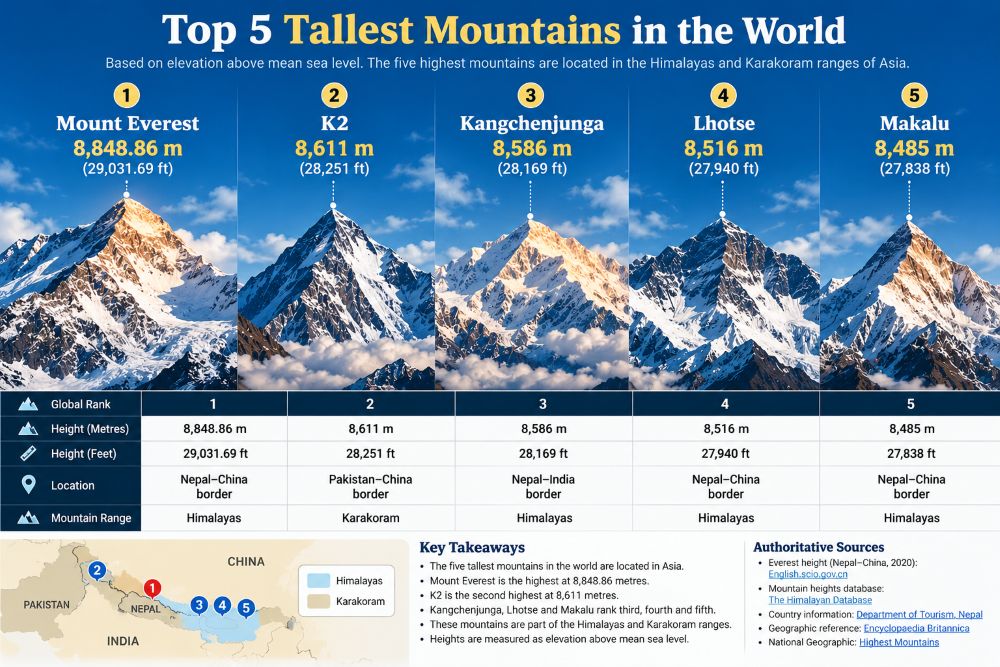
These peaks are renowned for their extreme elevations, glaciers, challenging terrain, and demanding climbing conditions. For reliable mountain-height information, consult the Department of Tourism, Nepal, and official announcements from the governments of Nepal and China.
| Rank | Mountain | Height (Metres) | Height (Feet) | Country or Region | Mountain Range |
|---|---|---|---|---|---|
| 1 | Mount Everest | 8,848.86 m | 29,031.69 ft | Nepal and China | Himalayas |
| 2 | K2 | 8,611 m | 28,251 ft | Pakistan and China | Karakoram |
| 3 | Kangchenjunga | 8,586 m | 28,169 ft | Nepal and India | Himalayas |
| 4 | Lhotse | 8,516 m | 27,940 ft | Nepal and China | Himalayas |
| 5 | Makalu | 8,485 m | 27,838 ft | Nepal and China | Himalayas |
| 6 | Cho Oyu | 8,188 m | 26,864 ft | Nepal and China | Himalayas |
| 7 | Dhaulagiri I | 8,167 m | 26,795 ft | Nepal | Himalayas |
| 8 | Manaslu | 8,163 m | 26,781 ft | Nepal | Himalayas |
| 9 | Nanga Parbat | 8,126 m | 26,660 ft | Pakistan | Himalayas |
| 10 | Annapurna I | 8,091 m | 26,545 ft | Nepal | Himalayas |
1. Mount Everest
The officially recognized elevation of Mount Everest is 8,848.86 meters (29,031.69 feet) above sea level, according to the joint Nepal and China measurement announced in 2020.
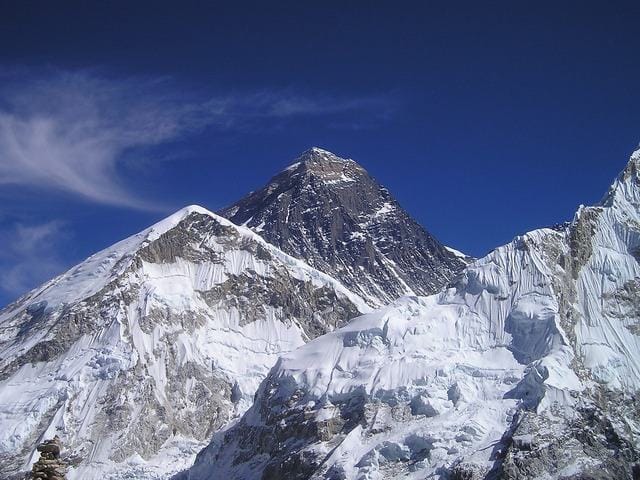
How Tall Is the Tallest Mountain in the World?
| Fact | Details |
|---|---|
| Tallest mountain by elevation above sea level | Mount Everest |
| Official height | 8,848.86 metres |
| Height in feet | 29,031.69 feet |
| Height in kilometers | 8.84886 km |
| Location | Nepal–China border |
| Mountain range | Himalayas |
| Official height announced | December 2020 |
| Other names | Sagarmatha and Chomolungma |
How Is the Height of the World’s Tallest Mountain Measured?
- Previous measurement: 8,848 meters was the widely used official figure.
- Updated measurement: Nepal and China jointly announced the new height of 8,848.86 meters in December 2020.
- Survey methods: Explain how modern surveying and satellite-based positioning help determine mountain elevation.
- Measurement reference: Clarify that the official figure measures elevation above sea level, including the summit’s snow cap.
2. K2: 8,611 Meters (28,251 Feet)
K2 is the world’s second-highest mountain, with a summit elevation of 8,611 meters (28,251 feet) above sea level. It lies in the Karakoram range along the Pakistan–China border.
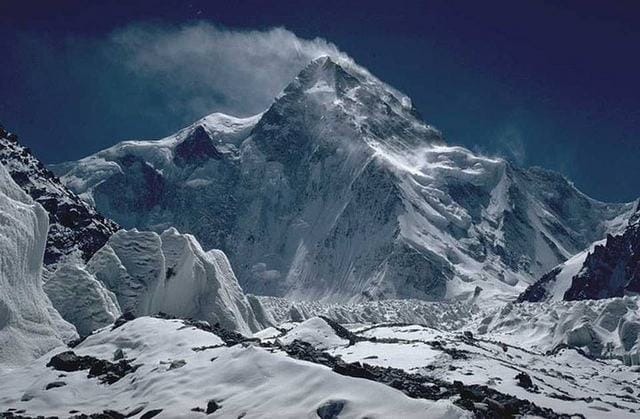
Also known as Mount Godwin-Austen, K2 is renowned for its steep slopes, technical climbing routes, and unpredictable weather. Its extreme altitude and challenging terrain make it one of the most demanding mountains for experienced mountaineers.
Unlike many popular trekking destinations, K2 demands extensive preparation, specialist equipment, and high-altitude climbing experience.
Quick facts about K2
- Height: 8,611 meters (28,251 feet)
- Global ranking: 2nd highest mountain
- Location: Pakistan–China border
- Mountain range: Karakoram
- Known for: Technical climbing and extreme weather
Authoritative reference: The Himalayan Database and its associated peak records provide a useful reference for Himalayan and Karakoram mountaineering information.
3. Kangchenjunga: 8,586 Meters (28,169 Feet)
Kangchenjunga is the world’s third-highest mountain, standing at 8,586 meters (28,169 feet) above sea level. It lies on the Nepal–India border, with its eastern side bordering the Indian state of Sikkim.
The mountain has five major peaks and holds cultural and religious significance for local communities. Its name is traditionally associated with the five treasures of the great snow.
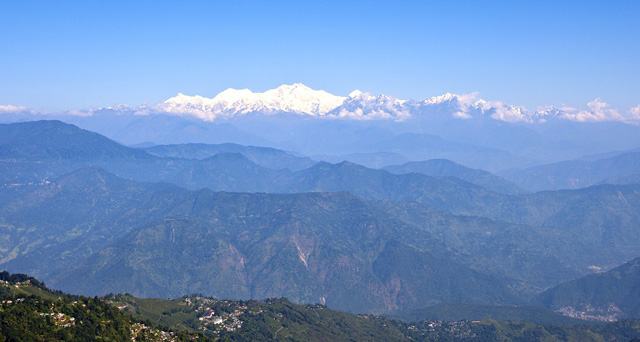
Kangchenjunga is known for its glaciers, rugged terrain, and demanding climbing conditions. The surrounding region also supports diverse Himalayan ecosystems and offers spectacular mountain landscapes.
Quick facts about Kangchenjunga
- Height: 8,586 meters (28,169 feet)
- Global ranking: 3rd highest mountain
- Location: Nepal–India border
- Mountain range: Himalayas
- Known for: Five major peaks and cultural significance
Authoritative reference: Nepal’s Department of Tourism lists Kangchenjunga at 8,586 metres on its mountain information page.
4. Lhotse: 8,516 Meters (27,940 Feet)
Lhotse is the world’s fourth-highest mountain, reaching 8,516 meters (27,940 feet) above sea level. It lies on the Nepal–China border and connects to Mount Everest via the South Col.
Lhotse is particularly notable for its steep south face, which presents serious technical challenges for climbers. Its proximity to Everest makes the two mountains closely associated with Himalayan mountaineering expeditions.
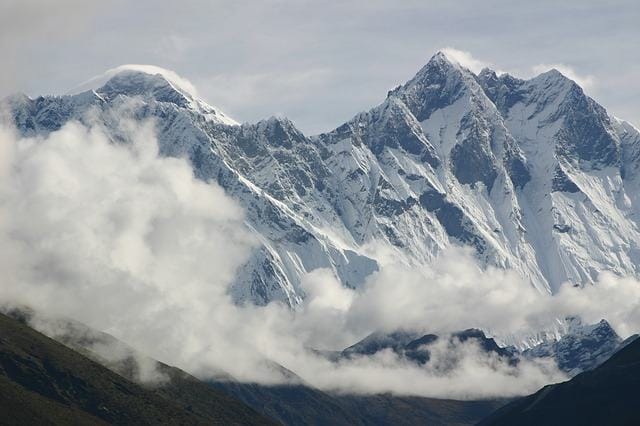
Despite its proximity to one of the world’s most frequently climbed eight-thousanders, Lhotse remains a formidable peak. Climbers must contend with extreme cold, high winds, avalanches, and altitude sickness.
Quick facts about Lhotse
- Height: 8,516 meters (27,940 feet)
- Global ranking: 4th highest mountain
- Location: Nepal–China border
- Mountain range: Himalayas
- Known for: Its steep south face and proximity to Everest
Authoritative reference: Nepal’s Department of Tourism and The Himalayan Database are useful sources for checking Lhotse’s elevation and mountaineering history.
5. Makalu
Makalu is the world’s fifth-highest mountain, standing at 8,485 meters (27,838 feet) above sea level. It lies on the Nepal–China border in the eastern Himalayas, southeast of Mount Everest.
Makalu is famous for its distinctive pyramid-shaped summit and steep ridges. Its exposed terrain, technical climbing, and unpredictable weather make reaching the summit a serious challenge.
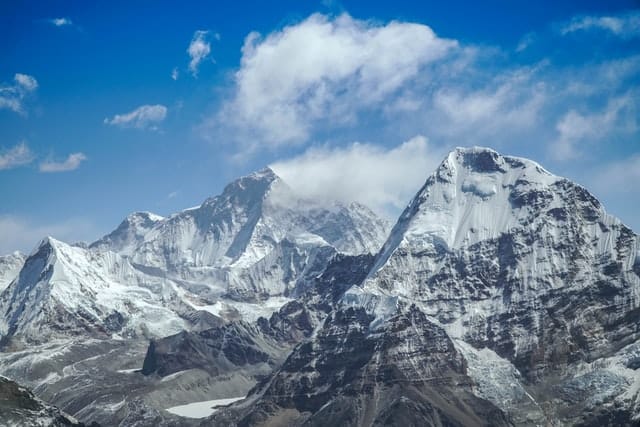
The surrounding Makalu-Barun region is also known for its forests, remote valleys, glaciers, and rich biodiversity.
Quick facts about Makalu
- Height: 8,485 meters (27,838 feet)
- Global ranking: 5th highest mountain
- Location: Nepal–China border
- Mountain range: Himalayas
- Known for: Its pyramid-shaped summit and steep ridges
Authoritative reference: The Himalayan Database’s peak list records Makalu at 8,485 meters. Nepal’s Department of Tourism also provides information about major Himalayan mountains.
6. Cho Oyu: 8,188 Meters (26,864 Feet)
Cho Oyu is commonly listed as the world’s sixth-highest mountain, at about 8,188 meters. It lies on the Nepal–China border in the Himalayas, west of Mount Everest.
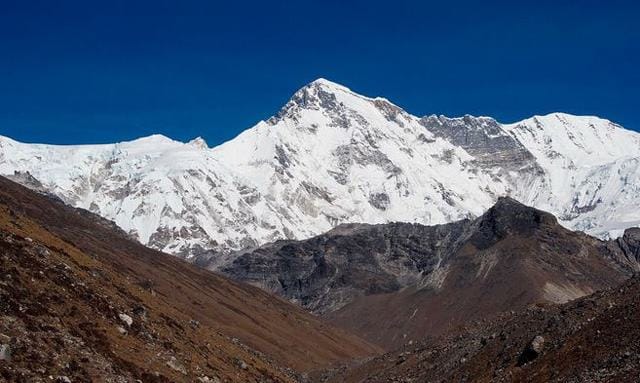
Its name is commonly translated as “Turquoise Goddess.” Compared with some other 8,000-meter peaks, Cho Oyu has historically been regarded as a more accessible climbing objective along its standard route. However, it remains an extremely high mountain, and expeditions face serious risks from altitude sickness, severe weather, avalanches, and other high-altitude hazards.
The first successful ascent took place on 19 October 1954, when Herbert Tichy, Joseph Jöchler, and Pasang Dawa Lama reached the summit.
Quick facts about Cho Oyu
- Height: 8,188 meters (26,864 feet)
- Global ranking: 6th highest mountain
- Location: Nepal–China border
- Mountain range: Himalayas
- Known for: Its high elevation and comparatively accessible established climbing routes
Authoritative reference: The Himalayan Database and established geographical references provide information on Cho Oyu’s elevation and climbing history.
5 Unique FAQs About the World’s Tallest Mountains
1. Do the tallest mountains have snow on their summits all year?
Most retain snow and ice year-round, but snow cover varies with weather and climate.
2. Why is K2 called the Untamed Mountain?
K2 earned this nickname because of its dangerous climbing routes, extreme weather, and challenging conditions.
3. Can earthquakes change a mountain’s height?
Yes. Earthquakes can shift the Earth’s crust, changing a mountain’s measured elevation.
4. Why are most of the world’s tallest mountains in Asia?
The collision of the Indian and Eurasian tectonic plates formed and uplifted the Himalayas.
5. Is climate change making the tallest mountains higher?
Not necessarily. Climate change affects snow and glaciers, while tectonic uplift, erosion, and earthquakes also influence mountain elevations.
Sources for References
- The 14 peaks above 8,000 meters: NASA Earth Observatory
- Mountain elevations and expedition records: The Himalayan Database
- Nepal’s mountain information: Department of Tourism, Nepal
- How mountain heights are measured: National Geographic – Measuring Mount Everest