Most people quit a new skill within the first few weeks. Not because they lack talent, but because nobody handed them a map. That’s exactly where expert tips for beginners come in not as a magic shortcut, but as a way to skip the years of trial and error that pros already went through so you don’t have to repeat their mistakes.
Here’s the thing about beginners: they tend to focus on the wrong stuff. They obsess over fancy equipment, chase advanced techniques before they’ve nailed the basics, and give up right around the point where things finally start clicking. Professionals, on the other hand, play a longer game. They build systems, ask for feedback constantly, and treat “boring” fundamentals as the actual foundation of everything impressive that comes later.

The gap between an amateur and a professional isn’t usually raw talent; it’s habits, structure, and patience. A pro practices with intention. A beginner just… practices, and hopes something sticks. That difference compounds over weeks and months until the gap looks enormous, even though it started small.
This guide walks through how to do it like a pro, whatever “it” happens to be for you: a new hobby, a craft, a sport, a job skill, or a creative pursuit. You’ll get a practical, step-by-step look at the mindset shifts, systems, and daily habits that separate fast learners from people who stay stuck. If you’re looking for genuine expert tips for beginners that go beyond generic motivation, you’re in the right place.
Start With the Right Mindset
Skills aren’t built in your hands first they’re built in your head. Before you touch a single tool or technique, the way you think about learning will determine how far you go.
Focus on Progress, Not Perfection
Perfectionism kills more beginner projects than laziness ever does. If you’re waiting until you can do something “right” before you’ll even attempt it, you’ll never start. Professionals didn’t skip the ugly, awkward phase; they just pushed through it faster because they expected it. Set the bar at “a little better than last week”, not “flawless”.
Accept Mistakes as Part of Learning
The small mistakes that quietly hold most people back, Here’s an uncomfortable truth: mistakes aren’t a sign you’re bad at something. They’re often the actual mechanism your brain uses to learn it. Researchers studying skill acquisition have found that errors, when reviewed and corrected, drive faster improvement than smooth, mistake-free repetition ever does. A useful breakdown of this idea, including practical ways to reframe setbacks instead of fearing them, is laid out in Psychology Today’s guide to building a growth mindset..
Develop Patience and Consistency
Nobody becomes “good” overnight, no matter how confident the highlight reels on social media make it look. What actually separates beginners who improve from beginners who plateau is patience paired with consistency: showing up regularly even when progress feels invisible. That combination, more than any single trick, is at the heart of nearly every set of expert tips for beginners you’ll come across.
Learn the Fundamentals First
It’s tempting to skip straight to the cool, advanced stuff. Resist that urge. Every professional you admire spent unglamorous hours on basics most beginners rush past.
Why Mastering Basics Matters
Fundamentals are the scaffolding everything else gets built on. A guitarist who never properly learns chord transitions will hit a hard ceiling later, no matter how many flashy techniques they pick up. A writer who skips sentence structure will struggle the moment a story gets complex. The basics aren’t beneath you; they’re underneath everything you’ll eventually do well.
Common Beginner Mistakes
New players often make the biggest mistake here that they see fundamentals as something to tick off the list, rather than as a skill to learn. They’ll play the basic version once or twice and be done with it, if “good enough” is the same as “solid.” “Ain’t.” Weak fundamentals almost always come back to haunt you later, and usually at the worst possible time, under pressure, in public, or with a deadline.
Building a Strong Foundation Before Advanced Techniques
A reasonable rule of thumb: don’t add complexity until the simpler version feels almost automatic. If you still have to think hard about a basic step, you’re not ready to layer something new on top of it. This is slower at first. It pays off enormously later.
Follow a Proven System
Guessing your way through a new skill wastes time. Following a structure that’s already worked for other people doesn’t. Instead of relying on fleeting bursts of motivation, focus on the small habits that build real consistency over time.”
Use Step-by-Step Frameworks
Whatever you’re learning, someone has almost certainly already mapped out a sensible order to learn it in. Find that framework instead of inventing your own from scratch. It removes a huge amount of decision fatigue. You’re not constantly wondering, “What should I work on next?” You’re just following the next step.
Learn From Experts Instead of Guessing
Beginners often assume they need to “discover” their own method to make it feel authentic. That’s mostly a myth. Even highly original professionals usually started by copying established systems, then deviated once they understood why those systems worked. MindTools has a solid breakdown of structured, intentional skill-building (as opposed to vague, unfocused repetition) in its piece on purposeful practice.
Create a Repeatable Process
Once you find a system that works, write it down. A repeatable process, even something as simple as a weekly checklist, keeps you from relying on motivation, which is unreliable, and replaces it with structure, which isn’t.
Practice Deliberately
There’s a difference between practicing and practicing well, and it’s bigger than most beginners realize.
Quality Over Quantity
Three focused, attentive practice sessions will outperform ten distracted ones. Deliberate practice means working right at the edge of your current ability — uncomfortable, a little frustrating, fully focused — rather than coasting through reps you’ve already mastered. This concept was popularized by psychologist Anders Ericsson, whose research is summarized in Harvard Business Review’s well-known piece, The Making of an Expert, which found that elite performers across fields shared this same disciplined approach to practice rather than any innate gift.
Set Specific Improvement Goals
“Get better at cooking” is too vague to act on. “Get my knife cuts consistent enough that pieces cook evenly” is something you can actually practice and check. Specific goals turn practice sessions into something measurable instead of just time spent.
Track Progress Regularly
Keep a simple log — even a few lines after each session. What did you work on? What felt hard? What clicked? This habit alone tends to accelerate learning, because it forces you to notice patterns you’d otherwise miss.
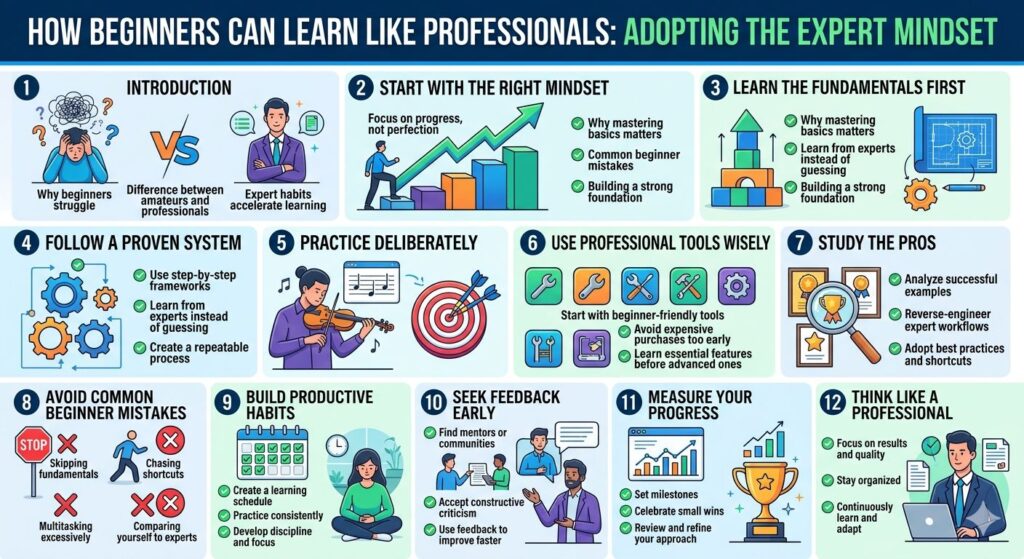
Use Professional Tools Wisely
Gear matters less than beginners think, and timing matters more.
Start With Beginner-Friendly Tools
Usually easier, cheaper, simpler tools are easier, not harder, to learn on. Professional level gear is often built for people that know what they are optimising for. Many beginners don’t yet – and no amount of expensive gear can fix that. A comparison guide to beginner friendly tools can save you from overspending before you even know what you need if you’re shopping around for your first setup.
Avoid Expensive Purchases Too Early
It’s a common (and expensive) trap: buy the pro-level kit, assume it’ll motivate you, then realize the gear was never the bottleneck. Skill was. Wait until you’ve hit a real limitation with your current tools before upgrading — you’ll know exactly what to look for by then.
Learn Essential Features Before Advanced Ones
Most tools, software included, have a small set of core features that cover 80% of real use cases. Learn those thoroughly first. The advanced settings will make far more sense once you understand why they exist.
Study the Pros
You don’t have to reinvent the path; you can study people who’ve already walked it.
Analyze Successful Examples
Pick a handful of people who do the thing you’re learning really well. Don’t just admire their results; study their process. What do they do differently in the first five minutes? Where do they spend most of their time?
Reverse-Engineer Expert Workflows
Break down what a pro actually does, step by step, instead of just the polished end result you see. A chef’s plated dish hides hours of prep work; a polished article hides several rough drafts. Understanding the hidden steps is often more useful than admiring the finished product.
Adopt Best Practices and Shortcuts
Pros develop shortcuts not because they’re cutting corners, but because they’ve identified which steps actually matter and which ones don’t. Borrowing these shortcuts rather than rediscovering them yourself through months of trial and error is one of the most underrated expert tips for beginners out there.
Avoid Common Beginner Mistakes
Some mistakes are so common they’re almost a rite of passage. Knowing them in advance can help you skip a few.
Skipping Fundamentals
Already covered above, but worth repeating: this is probably the single biggest reason beginners plateau early.
Chasing Shortcuts
There’s a difference between a smart shortcut (borrowed from someone experienced) and a lazy one (skipping practice you actually need). Beginners often can’t yet tell the two apart, which is exactly why fundamentals and feedback matter so much early on.
Multitasking Excessively
Trying to improve five things at once usually means improving none of them well. Pick one or two specific weaknesses per practice block, not an entire skill set.
Comparing Yourself to Experts
Comparing your week-three attempt to someone’s ten-year career is a fast way to feel discouraged for no good reason. Compare this month’s version of yourself to last month’s instead.
Build Productive Habits
Talent gets a lot of credit it doesn’t deserve. Habits are usually doing the actual work. Mastering your time means recognizing the productivity tricks that are easy to overdo before they start draining your energy
Create a Learning Schedule
Vague intentions (“I’ll practice when I have time”) rarely survive a busy week. A fixed schedule, even just 15–20 minutes at the same time daily, removes the need to decide each day whether you feel like practicing.
Practice Consistently
Consistency beats intensity for skill-building. James Clear’s widely referenced guide to building habits makes a similar point: small, repeated actions compound into significant change far more reliably than occasional bursts of intense effort. For more structured ways to build a consistent routine, worldlistmania.com’s roundup of productivity habits that actually work is worth a look.
Develop Discipline and Focus
Discipline isn’t about willpower in the moment; it’s about designing your environment and schedule so the right choice is the easy one. Remove friction (lay out your tools the night before, block off the calendar slot) and discipline gets a lot less dramatic.
Seek Feedback Early
Practicing in a vacuum is one of the slowest ways to improve.
Find Mentors or Communities
You don’t need a formal mentor to get the benefit of an outside perspective. In online communities, in local groups, or even in a friend a few steps ahead of you, there are blind spots you can’t see yourself. If you don’t know where to start looking, worldlistmania.com’s list of the best ways to learn new skills fast has a few good options for finding people and resources worth learning from.
Accept Constructive Criticism
Feedback stings a little; that’s normal. The goal isn’t to feel good about every comment; it’s to extract the one or two useful points buried inside it and ignore the rest.
Use Feedback to Improve Faster
Feedback only helps if you actually act on it. Keep a running list of the same correction if it keeps coming up — that’s usually your highest-leverage area to fix next.
Measure Your Progress
What gets measured tends to get improved. What doesn’t get measured tends to feel stuck even when it isn’t.
Set Milestones
Break the long road to “good at this” into smaller checkpoints. Milestones give you something concrete to aim for instead of an abstract, far-off goal that’s hard to feel motivated about.
Celebrate Small Wins
It’s easy to dismiss small improvements as “not a big deal”. String enough of them together, though, and that’s literally what mastery is made of. Acknowledge them.
Review and Refine Your Approach
Every few weeks, look back at what’s working and what isn’t. Maybe your schedule needs adjusting, or a particular drill stopped being useful. Treat your learning process itself as something you improve, not just a fixed plan you follow blindly.
Think Like a Professional
This is really the thread tying every section above together.
Focus on Results and Quality
Professionals care less about looking busy and more about whether the output actually holds up. Ask yourself honestly: would this pass a professional’s standard, or does it just look finished to an untrained eye?
Stay Organized
Messy notes, scattered practice sessions, and no clear plan make progress harder to see and easier to abandon. A little organisation, a notebook, a folder, and a simple tracker go a long way.
Continuously Learn and Adapt
Even professionals at the top of their field keep adjusting their approach. Treating mastery as a finish line, rather than an ongoing process, is one habit beginners eventually have to unlearn if they want to keep growing.
Expert Tips Box
Quick-Reference Expert Tips for Beginners
- Master one skill before adding another.
- Learn from mistakes instead of avoiding them.
- Practice daily, even if only for 15 minutes.
- Use checklists and workflows.
- Never stop improving your fundamentals.
Key Takeaways
- The gap between beginners and professionals is mostly built from habits and structure, not raw talent.
- Mindset (progress over perfection) shapes how far and how fast you improve.
- Strong fundamentals make every advanced skill easier to learn later.
- Deliberate, focused practice beats long, unfocused practice every time.
- Feedback and community accelerate progress far more than solo trial and error.
- Tracking milestones keeps motivation alive during slow stretches.
- Thinking like a professional is a daily habit, not a one-time switch you flip.
External Sources
- Harvard Business Review — The Making of an Expert
- James Clear — The Habits Guide
- MindTools — Purposeful Practice
- Psychology Today — 15 Ways to Build a Growth Mindset
- American Psychological Association — Growth Mindset Podcast
Frequently Asked Questions
How long does it take to become good at a new skill?
It depends heavily on the skill and how deliberately you practice, but most people notice real competence within a few months of consistent, focused effort — not necessarily mastery, but a clear, visible improvement over where they started.
What is the fastest way to learn like a professional?
Combine deliberate practice with regular feedback. Practicing alone helps; practicing with correction from someone more experienced tends to cut the learning curve significantly.
Should beginners buy professional tools immediately?
No. Beginner-friendly, lower-cost tools are usually easier to learn on. Upgrade once you understand specifically what limitation you’ve outgrown, not before.
How can I stay motivated when learning?
Set small, specific milestones and track them. Motivation fluctuates naturally, but visible progress — even minor progress — tends to keep people going through the slow stretches.
What habits separate professionals from beginners?
Consistency, deliberate practice, regular feedback-seeking, and a willingness to revisit fundamentals even after they’ve moved on to advanced techniques.
Why do many beginners quit too early?
Usually because they expect faster results than skill acquisition realistically allows, then mistake a normal plateau for a sign they’re “not cut out for it.”
How important is feedback for improvement?
Very. Self-practice alone often reinforces small errors without you realizing it. Outside feedback catches blind spots that are nearly impossible to see on your own.
Can anyone learn a skill to a professional level?
Most people can reach a strong, competent level with the right system and enough deliberate practice. True professional-level mastery also depends on time invested, quality of feedback, and how consistently the practice continues over years, not just months.