Let’s be honest — most of us are quietly sabotaging ourselves.
Not because we’re lazy or careless, but because certain mistakes feel so normal, so woven into everyday life, that we don’t even recognize them as mistakes. We stay up scrolling until midnight, check our phones 100 times a day, skip doctor’s appointments, and tell ourselves we’ll “get to it tomorrow.”

The cost? Lost energy, missed opportunities, strained relationships, and a growing gap between where we are and where we want to be.
This article is your wake-up call. We’re breaking down the most common mistakes you’re probably making right now — across productivity, health, money, mindset, and relationships — and giving you clear, research-backed fixes you can start applying today.
No vague advice. No fluff. Just real, actionable steps to help you stop repeating the same costly errors.
Mistake #1: Ignoring the Power of Sleep
Why It’s a Problem
Most people treat sleep like a luxury. In reality, it’s the single most powerful performance tool available to you — and it costs nothing.
According to the Centers for Disease Control and Prevention (CDC), more than 1 in 3 American adults don’t get enough sleep on a regular basis. Chronic sleep deprivation is linked to increased risk of obesity, heart disease, diabetes, and mental health disorders.
Research published by the National Sleep Foundation shows that adults need 7–9 hours of sleep per night for optimal cognitive function, emotional regulation, and physical recovery.
The Fix
- Set a hard bedtime — pick a time and protect it like a meeting.
- Create a wind-down routine — dim lights 1 hour before bed, avoid screens, and consider journaling or light stretching.
- Keep your room cool and dark — the ideal sleep temperature is between 60–67°F (15–19°C).
- Avoid caffeine after 2 PM — caffeine has a half-life of 5–6 hours, meaning afternoon coffee still disrupts sleep.
- Track your sleep — use a simple journal or a wearable to understand your patterns.
Mistake #2: Multitasking Instead of Deep Work
Why It’s a Problem
You think you’re being productive. You’re actually destroying your focus.
A landmark study from Stanford University found that heavy multitaskers performed worse on every cognitive task tested — including filtering irrelevant information, organizing memory, and switching between tasks. The myth of effective multitasking has been thoroughly debunked by neuroscience.
Every time you switch tasks, your brain pays a “switching cost” — a tax on your attention that can take up to 23 minutes to fully recover from, according to research from the University of California, Irvine.
The Fix
- Time-block your calendar — assign specific time slots to specific tasks.
- Work in 90-minute deep work sprints, inspired by Cal Newport’s work outlined in Deep Work.
- Turn off all non-essential notifications during focus periods.
- Use the “one tab rule” — keep only the browser tab you need open.
- Batch similar tasks (emails, calls, admin work) to minimize context switching.
Mistake #3: Spending Without a Budget
Why It’s a Problem
Not knowing where your money goes is like driving with no GPS and a leaking gas tank.
The Consumer Financial Protection Bureau (CFPB) consistently reports that financial stress is one of the leading causes of anxiety and relationship strain. Yet a Gallup poll found that only 1 in 3 American households follow a detailed monthly budget.
Without a budget, you’re reacting to your bank account instead of directing your financial life.
The Fix
- Track all spending for 30 days — use an app like Mint, YNAB (You Need A Budget), or even a spreadsheet.
- Apply the 50/30/20 rule: 50% on needs, 30% on wants, 20% on savings and debt repayment.
- Automate your savings — transfer a set amount to savings the day you get paid so you never “accidentally” spend it.
- Review your subscriptions monthly — the average person forgets about $200+ in recurring charges per month.
- Set monthly financial check-ins — 30 minutes once a month can transform your finances over a year.
Mistake #4: Neglecting Mental Health Until It’s a Crisis
Why It’s a Problem
We treat mental health the way we treat car maintenance — we ignore it until something breaks down completely.
The World Health Organization (WHO) reports that 1 in 8 people worldwide live with a mental disorder, yet most don’t seek help until symptoms become severe. Anxiety and depression are among the leading causes of disability globally.
Waiting for a crisis before addressing mental wellness is like only going to the doctor when you’re in the hospital. Prevention and maintenance matter enormously.
The Fix
- Schedule mental health check-ins — a weekly 10-minute self-reflection is more effective than a yearly crisis.
- Start therapy proactively, not reactively. Platforms like BetterHelp make it more accessible than ever.
- Build daily micro-habits: 5 minutes of journaling, a gratitude practice, or even a short walk.
- Limit social media — the American Psychological Association (APA) has linked heavy social media use to increased anxiety and depression, especially in young adults.
- Talk to someone you trust — human connection is medicine.
Mistake #5: Skipping Physical Activity
Why It’s a Problem
Sedentary behavior is now classified as a major public health risk — right alongside smoking and poor diet.
The World Health Organization recommends at least 150 minutes of moderate-intensity physical activity per week for adults. Yet according to their data, more than 25% of the global adult population is insufficiently active.
Regular exercise isn’t just about looking better. It reduces the risk of chronic disease, improves mood through endorphin release, sharpens cognitive function, and even improves sleep quality.
The Fix
- Start small and be consistent — 20 minutes of walking daily beats sporadic intense workouts.
- Schedule movement like meetings — block it in your calendar and treat it as non-negotiable.
- Find movement you actually enjoy — cycling, dancing, swimming, martial arts. Compliance beats optimization.
- Use the “2-minute rule” — when resistance strikes, commit to just 2 minutes. You’ll almost always continue.
- Take the stairs, walk during calls, park farther away — incidental movement adds up significantly over time.
Mistake #6: Living in Reactive Mode
Why It’s a Problem
If your morning starts with checking emails or scrolling social media, you’re handing control of your day to someone else.
Reactive people respond to the loudest inputs rather than their own priorities. They end every day feeling busy but unfulfilled, wondering where the time went.
Research from Harvard Business Review shows that how you spend the first 60 minutes of your morning directly shapes your mindset and performance for the rest of the day.
The Fix
- Implement a morning routine that starts without your phone for the first 30–60 minutes.
- Identify your “Big 3” — three things that must get done today — before looking at email or messages.
- Use a “not to-do” list — identify distractions and time-wasters to actively avoid.
- Do your most important work before 12 PM, when cognitive energy and willpower are highest.
- Batch your email and messages — check them at set times (e.g., 9 AM, 1 PM, 5 PM) rather than continuously.
Mistake #7: Surrounding Yourself With the Wrong People
Why It’s a Problem
Jim Rohn’s famous quote holds up to scientific scrutiny: “You are the average of the five people you spend the most time with.”
A landmark 32-year study published in the New England Journal of Medicine found that behaviors like smoking, obesity, and happiness spread socially through networks. Your circle quite literally shapes your habits, ambitions, and worldview.
Staying in low-energy, negative, or unsupportive social environments has a measurable cost on your potential.
The Fix
- Audit your social circle — who energizes you? Who drains you?
- Spend more intentional time with people who challenge and inspire you.
- Join communities aligned with your goals — masterminds, professional associations, local clubs.
- Set boundaries with chronic negativity — you don’t have to cut people off, but you can limit exposure.
- Seek mentors actively — one conversation with the right person can save you years of mistakes.
Mistake #8: Avoiding Difficult Conversations
Why It’s a Problem
Avoiding hard conversations feels like protecting peace. In reality, it creates a debt that compounds over time.
Unaddressed conflicts in relationships, workplaces, and families build resentment, miscommunication, and disconnection. Research from the Gottman Institute — a world leader in relationship research — shows that avoidance and stonewalling are two of the strongest predictors of relationship failure.
Brave conversations build trust. Avoiding them destroys it slowly.
The Fix
- Use the “I feel” framework — “I feel [emotion] when [situation] because [reason]” reduces defensiveness.
- Prepare, don’t rehearse obsessively — know your key point, but stay open to the other person’s perspective.
- Choose the right time and place — don’t have hard conversations when either party is hungry, tired, or rushed.
- Assume good intent — most people aren’t trying to harm you; they’re operating from their own blind spots.
- Follow up after — a brief check-in post-conversation reinforces care and resolution.
Mistake #9: Not Investing in Continuous Learning
Why It’s a Problem
The half-life of skills is shrinking. What made you valuable 10 years ago may be obsolete today.
The World Economic Forum’s Future of Jobs Report projects that 44% of workers’ core skills will be disrupted in the next five years, driven by AI, automation, and shifting industry demands. Those who don’t learn consistently will be left behind.
Beyond career implications, learning keeps the brain sharp. Research shows that intellectual stimulation reduces the risk of cognitive decline and dementia as we age.
The Fix
- Commit to reading 10 pages a day — that’s roughly 12 books per year.
- Use your commute intentionally — podcasts, audiobooks, and language apps turn dead time into learning time.
- Take one online course per quarter — platforms like Coursera, edX, and LinkedIn Learning offer world-class content for free or low cost.
- Teach what you learn — explaining concepts to others is the fastest way to deeply understand them.
- Apply learning immediately — knowledge without implementation is just trivia.
Mistake #10: Confusing Busyness With Productivity
Why It’s a Problem
Busyness is often a disguise for avoidance.
Checking emails all day, attending back-to-back meetings, and constantly “doing things” can feel productive while actually moving you further from what matters. Activity is not output.
As productivity expert Greg McKeown argues in Essentialism, the disciplined pursuit of less is the key to a more meaningful and productive life. Doing fewer things — but doing them with full attention and intention — consistently outperforms doing many things poorly.
The Fix
- End each day by listing tomorrow’s three most important tasks (MITs) — not your full to-do list.
- Say no more often — to commitments, meetings, and requests that don’t align with your priorities.
- Measure output, not hours — what did you actually complete and deliver today?
- Eliminate, automate, delegate — before adding a new task to your list, ask if it can be removed entirely.
- Review weekly — spend 30 minutes every Friday evaluating what moved the needle and what was just noise.
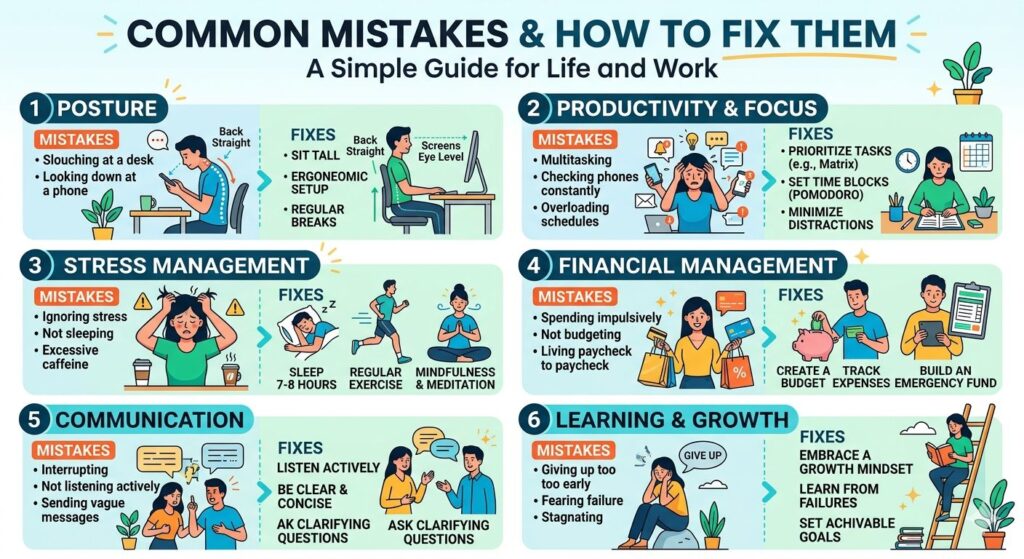
A Simple Guide for Life and Work
Key Takeaways
- Sleep is not optional — protect it as fiercely as you protect your most important commitments.
- Focus beats multitasking every single time — do one thing at a time with full attention.
- Budget proactively — money without direction disappears.
- Mental health is a daily practice, not an emergency response.
- Move your body regularly — 20 minutes a day has a compounding impact on everything else.
- Own your mornings — whoever controls your first hour shapes your entire day.
- Your network is your net worth — be intentional about who you spend time with.
- Hard conversations save relationships — avoidance is the real relationship killer.
- Learning is compounding — invest in it daily, and the returns are extraordinary.
- Busy ≠ productive — protect your time and direct it toward what actually matters.
FAQs
The most common mistake is operating on autopilot—going through life reactively without intention. This often appears as poor sleep habits, reactive phone use, mindless spending, and avoiding the hard work of personal growth. Awareness is the first step toward positive change.
Repetitive mistakes are often driven by unconscious habits and unchallenged beliefs. A practical solution is to follow a three-step process: Notice the pattern, understand the root cause, and replace it with a deliberate new behavior. Journaling, therapy, and trusted feedback from others can accelerate this process.
The popular idea that habits form in 21 days is a myth. Research from University College London published in the European Journal of Social Psychology found that habit formation takes an average of 66 days, although it can range from 18 to 254 days depending on the person and behavior. Consistency and patience matter more than speed.
Multitasking can work for simple routine activities, such as folding laundry while listening to a podcast. However, for tasks that require concentration, creativity, or precision, multitasking typically reduces performance and increases mistakes. Single-tasking is usually the more effective approach.
A simple question can help: “Did I move my most important goal forward today?” Completing many small tasks may create the feeling of productivity, but if you did not make progress on your key objective, you were likely busy rather than productive. Focus on results instead of activity.
Shift your mindset from shame to curiosity. Instead of asking, “Why am I so stupid?” ask, “What can I learn from this experience?” Research by Carol Dweck on growth mindset suggests that people who view failures as opportunities for learning consistently perform better than those who see them as evidence of fixed ability.
Yes. Behavioral science research shows that habits, attitudes, beliefs, and even financial outcomes are often influenced by the people we spend the most time with. Being intentional about your social environment can have a significant impact on your personal and professional growth.
Avoid trying to change everything at the same time. Choose one mistake or habit to focus on each month and work on it until the new behavior starts to feel natural. Once it becomes part of your routine, introduce the next improvement. Small, consistent changes compound into significant long-term results.
Conclusion
The most dangerous mistakes aren’t the dramatic, obvious ones. They’re the quiet, everyday ones — the skipped sleep, the avoided conversation, the budget never written, the focus never protected.
Each one feels small in isolation. But stacked together over months and years, they’re the gap between the life you have and the life you’re capable of.
The good news? Every single mistake on this list is fixable. Not overnight, and not all at once but with clear awareness, a willingness to be honest with yourself, and deliberate daily action, you can turn these common errors into lasting strengths.
Start with one. Pick the mistake that resonates most and apply the fix this week. Then keep going.
The compounding effect of small corrections over time is extraordinary. Your future self is waiting.