Arthropods are the largest and most diverse group of animals on Earth. Scientists have described more than 1.2 million species, and many more remain undiscovered. They belong to the phylum Arthropoda, which includes insects, spiders, crabs, lobsters, centipedes, millipedes, and many other invertebrates.
All arthropods share several defining characteristics:
- A hard external skeleton (exoskeleton)
- Segmented bodies
- Jointed legs
- Growth through molting
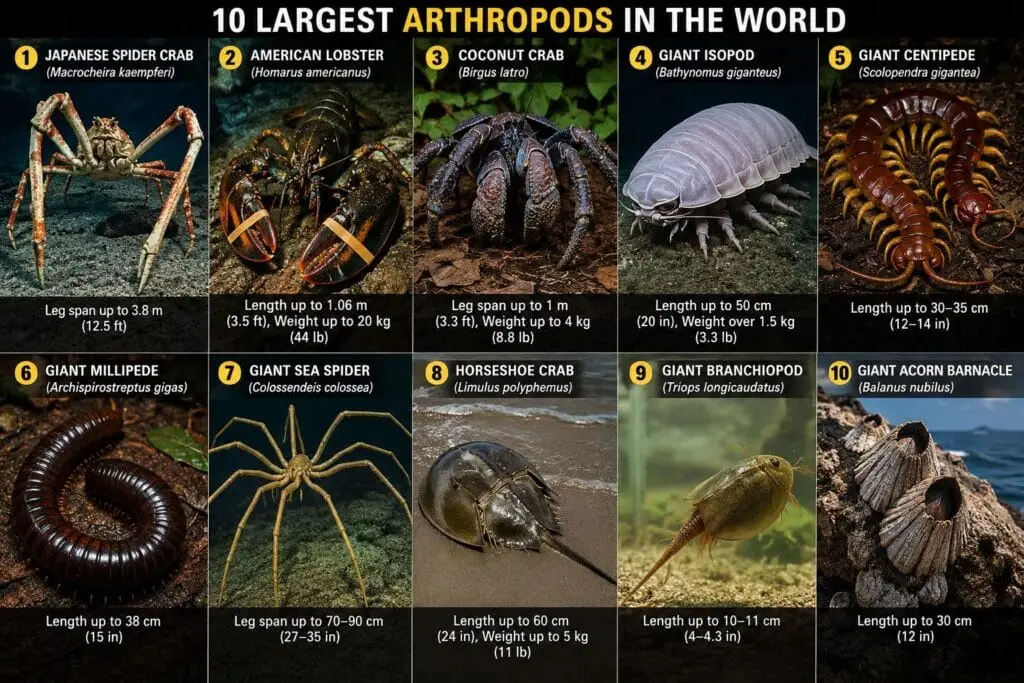
Although most arthropods are relatively small, some species have evolved into impressive giants. These enormous animals inhabit tropical forests, deep oceans, rocky coastlines, and even underground caves. Their remarkable size has fascinated scientists and wildlife enthusiasts for centuries.
Largest Arthropods at a Glance
| Rank | Arthropod | Maximum Size | Habitat |
|---|---|---|---|
| 1 | Japanese Spider Crab | Leg span up to 3.8 m (12.5 ft) | Northwest Pacific Ocean |
| 2 | American Lobster | Up to 20 kg (44 lb) | North Atlantic Ocean |
| 3 | Coconut Crab | Leg span about 1 m (3.3 ft) | Indo-Pacific islands |
| 4 | Giant Isopod | Up to 50 cm (20 in) | Deep ocean |
| 5 | Giant Centipede | Up to 30–35 cm (12–14 in) | South America |
| 6 | Giant African Millipede | Up to 38 cm (15 in) | East Africa |
| 7 | Giant Sea Spider | Leg span up to 70–90 cm | Antarctic Ocean |
| 8 | Horseshoe Crab | Up to 60 cm (24 in) | Coastal waters |
| 9 | Giant Branchiopod | Around 10–11 cm | Temporary freshwater pools |
| 10 | Giant Acorn Barnacle | Up to 30 cm | Rocky coastlines |
1. Japanese Spider Crab
The Japanese spider crab (Macrocheira kaempferi) is the largest living arthropod by leg span. Despite its intimidating appearance, this giant crab is a slow-moving scavenger that spends most of its life on the seafloor around Japan.
Adult males can develop a leg span of 3.8 metres (12.5 feet), while their body measures about 40 cm across. Some individuals weigh nearly 19 kilograms (42 pounds).
The species inhabits depths of 150 to 300 metres, where it feeds on dead animals, shellfish, and marine plants. Its extremely long legs help it navigate the ocean floor and reach food hidden among rocks.
Key facts
- Scientific name: Macrocheira kaempferi
- Maximum leg span: 3.8 m (12.5 ft)
- Weight: Up to 19 kg
- Distribution: Coastal waters of Japan
- Diet: Scavenger and opportunistic predator
2. American Lobster
The American lobster (Homarus americanus) holds the record as the world’s heaviest crustacean. A famous specimen caught off Nova Scotia in 1977 measured approximately 1.06 metres (3.5 feet) and weighed 20.14 kilograms (44.4 pounds).
Most lobsters are far smaller, but they continue growing throughout their lives by shedding their exoskeletons. Scientists believe exceptionally large lobsters may be several decades old.
American lobsters inhabit cold waters along the Atlantic coast of North America, where they prey on fish, mollusks, sea urchins, and other crustaceans.
Key facts
- Scientific name: Homarus americanus
- Maximum weight: 20.14 kg
- Maximum length: About 1.06 m
- Habitat: North Atlantic Ocean
- Lifespan: More than 50 years
3. Coconut Crab
The coconut crab (Birgus latro) is the world’s largest terrestrial arthropod. Unlike true crabs that spend their lives in water, coconut crabs live on tropical islands across the Indian and Pacific Oceans.
Adults can weigh up to 4 kilograms and reach a leg span of about one metre. Their enormous claws generate one of the strongest pinching forces measured in crustaceans.
Although they are famous for climbing coconut trees, researchers have found that they eat a varied diet consisting of fruits, seeds, carrion, smaller animals, and occasionally coconuts.
Because of habitat loss and overharvesting, coconut crab populations have declined in several regions.
4. Giant Isopod
The giant isopod (Bathynomus giganteus) looks like an oversized pill bug, but it lives thousands of metres beneath the ocean’s surface.
These deep-sea crustaceans commonly reach 30 to 36 centimetres, while the largest individuals exceed 50 centimetres in length and weigh over 1.5 kilograms.
Giant isopods survive in an environment where food is scarce. Consequently, they can go several months without eating. When food finally becomes available, they consume dead whales, fish, squid, and other marine animals.
Their large eyes, armored body, and slow metabolism help them thrive under extreme pressure and near-freezing temperatures.
5. Giant Centipede
The Amazonian giant centipede (Scolopendra gigantea) is the largest living centipede on Earth.
Adults typically grow between 25 and 30 centimetres, although exceptional specimens exceed 33 centimetres in length.
Unlike many smaller centipedes, this species actively hunts vertebrates, including frogs, lizards, snakes, bats, rodents, and birds. It injects venom through modified front legs called forcipules before consuming its prey.
The giant centipede inhabits tropical forests throughout northern South America and several Caribbean islands.
6. Giant African Millipede
The giant African millipede (Archispirostreptus gigas) ranks among the longest millipedes alive today.
Adults often measure 30 to 38 centimetres in length and possess hundreds of legs, although they never actually have one thousand.
Unlike centipedes, millipedes feed primarily on decaying leaves, wood, and other organic matter. This makes them important recyclers in forest ecosystems because they help break down dead plant material and enrich the soil.
Scientists also recognize the extinct Arthropleura as the largest arthropod ever discovered. Fossil evidence suggests it reached lengths of more than 2.5 metres (8 feet) during the Carboniferous Period, making it far larger than any living millipede.
Key Takeaways
- Arthropods are Earth’s most diverse group of animals.
- The Japanese spider crab has the greatest leg span of any living arthropod.
- The American lobster is the heaviest known living crustacean.
- The coconut crab is the world’s largest land-dwelling arthropod.
- Giant isopods, sea spiders, and horseshoe crabs have adapted to survive in challenging marine environments.
- The extinct Arthropleura remains the largest arthropod known from the fossil record.