Ever wondered which runway you could get lost on for an entire afternoon? The largest airports in the world aren’t just busy; some are so sprawling they’d swallow entire small nations. King Fahd International Airport in Dammam, for one, covers more ground than the country of Bahrain. Size tells a different story than traffic, though. Atlanta handles more passengers than anywhere else on Earth, yet it doesn’t even crack the top fifteen by land area.
This guide ranks the largest airports in the world by square kilometers and by passenger volume, using the freshest figures available for 2025 and 2026.
Hover over markers on the map to find information on the world’s largest airports
Quick Read: Top 10 Largest Airports by Land Area
| Rank | Airport | Code | Country | Land Area | Opened |
|---|---|---|---|---|---|
| 1 | King Fahd International Airport | DMM | Saudi Arabia | 776 km² (300 sq mi) | 1999 |
| 2 | King Khalid International Airport | RUH | Saudi Arabia | 375 km² (145 sq mi) | 1983 |
| 3 | Denver International Airport | DEN | United States | 135.7 km² (52.4 sq mi) | 1995 |
| 4 | King Abdulaziz International Airport | JED | Saudi Arabia | 105 km² (40 sq mi) | 1981 |
| 5 | Kuala Lumpur International Airport | KUL | Malaysia | 100 km² (39 sq mi) | 1998 |
| 6 | Istanbul Airport | IST | Turkey | 76.5 km² (29.5 sq mi) | 2018 |
| 7 | Dallas/Fort Worth International Airport | DFW | United States | 69.7 km² (27 sq mi) | 1974 |
| 8 | Orlando International Airport | MCO | United States | 53.8 km² (21 sq mi) | 1981 |
| 9 | Washington Dulles International Airport | IAD | United States | 47.8 km² (18.5 sq mi) | 1962 |
| 10 | Beijing Daxing International Airport | PKX | China | 47 km² (18 sq mi) | 2019 |
1. King Fahd International Airport (KFIA)
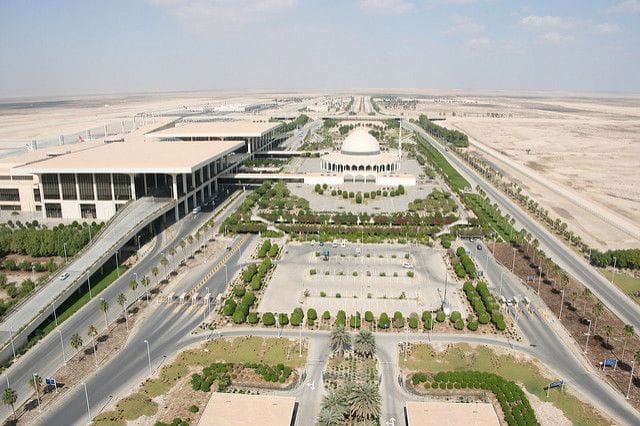
There’s really no contest at the top. King Fahd International Airport is, by a wide margin, the largest airport in the world, nearly six times bigger than the runner-up. Built originally as a US military airbase, it opened to commercial traffic in 1999 and now spans roughly 776 square kilometers of Eastern Province desert. Here’s the surprising part: only about 5% of that land actually gets used for runways, taxiways, and terminals. The rest sits in reserve, a kind of long-term insurance policy against future growth.
The airport houses a mosque that seats 2,000 worshippers, a dedicated Royal Terminal, and even a small residential community for staff. Its main runway stretches 4,000 meters, wide enough to handle anything currently flying commercially.
- Location: Dammam, Saudi Arabia
- Passengers (annual): ~9.7 million
- Land area: 776 km² (300 sq mi)
2. King Khalid International Airport (KKIA)
Riyadh’s main gateway is the second-largest airport in the world by land allocation, at roughly 375 square kilometers, though you’ll see it listed anywhere from 225 to 375 km², depending on whether the source counts undeveloped reserve land. Opened in 1983 and designed by the architecture firm HOK, King Khalid features five passenger terminals, a Royal Terminal, and parking for 11,600 vehicles. Its mosque holds the largest stained-glass installation of its kind, a striking detail most passengers never notice while sprinting for a connection. In 2024 the airport handled over 37 million travelers, and Saudi Arabia’s Vision 2030 aviation push means that number is only heading up.
- Location: Riyadh, Saudi Arabia
- Passengers (2024): 37,000,000+
- Land area: ~375 km² (145 sq mi)
3. Denver International Airport (DIA)
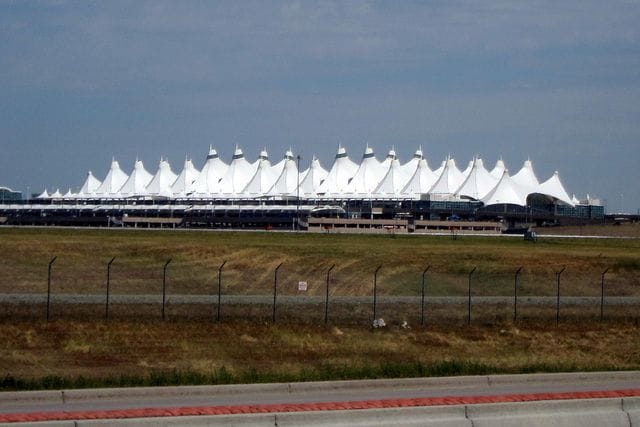
Denver International is the largest airport in the United States and North America’s biggest by a comfortable margin, covering 135.7 square kilometers of Colorado prairie. It replaced the aging Stapleton Airport in 1995, and, love it or hate it, its Teflon-peaked roof (meant to echo the Rocky Mountains) has spawned more conspiracy theories about underground tunnels than any airport has a right to. Denver set an all-time passenger record above 82 million in 2024, and its six runways handle well over 600,000 flight operations annually.
- Location: Denver, USA
- Passengers: 82,000,000+ (2024 record)
- Land area: 135.7 km² (52.4 sq mi)
4. King Abdulaziz International Airport (Jeddah, Saudi Arabia)
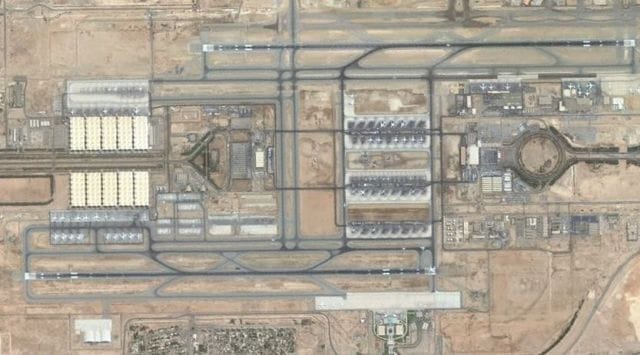
Jeddah’s airport occupies roughly 105 square kilometers and functions as Saudi Arabia’s primary gateway for Hajj and Umrah pilgrims, moving upward of 70% of the country’s annual pilgrim traffic. The 2019 opening of the new Terminal 1 — which alone spans 810,000 square meters — turned KAIA into one of the more modern hubs anywhere in the Gulf. 2025 was a landmark year here: the airport crossed 53.4 million passengers for the first time, edging past Riyadh to become the busiest airport in the Kingdom.
- Location: Jeddah, Saudi Arabia
- Passengers (2025): 53,400,000
- Land area: ~105 km² (40 sq mi)
5. Kuala Lumpur International Airport (Sepang, Malaysia)
KLIA covers around 100 square kilometers of former palm oil plantation south of the Malaysian capital. Architect Kisho Kurokawa built the place around an “airport in the forest, forest in the airport” concept, and honestly, it shows lush landscaping runs right through the terminal buildings. Malaysia Airlines and AirAsia both hub here, with AirAsia alone accounting for over a third of all flights, which makes KLIA the largest low-cost carrier megahub anywhere. In 2025, passenger numbers jumped 11% year-on-year to reach 63.4 million, one of the sharpest gains among any of the largest airports in the world this year.
- Location: Sepang, Malaysia
- Passengers (2025): 63,400,000
- Land area: 100 km² (39 sq mi)
6. Istanbul Airport, Turkey
Opened in 2018 to replace the aging Atatürk Airport, Istanbul Airport spans 76.5 square kilometers on the European side of the city. It’s the youngest true mega-airport on this list, and it’s not finished growing. The eventual plan calls for a capacity of 200 million passengers a year once all phases are built out. For now, four runways and Turkish Airlines’ hub operations already make it the busiest airport in Europe and one of the busiest worldwide by total traffic.
- Location: Istanbul, Türkiye
- Passengers (recent annual): 64,000,000+
- Land area: 76.5 km² (29.5 sq mi)
7. Dallas/Fort Worth International Airport
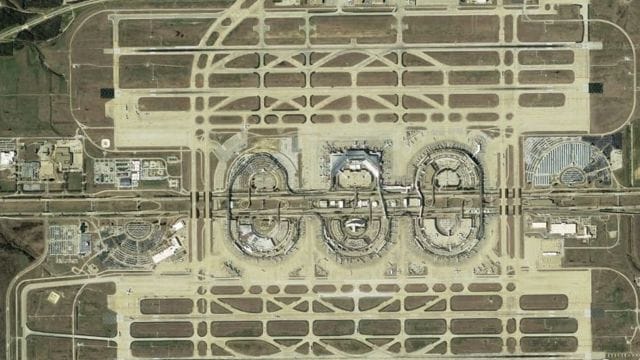
DFW covers 69.7 square kilometers between its two namesake cities, bigger than the island of Manhattan, as locals like to point out. It’s been American Airlines’ primary hub since opening in 1974, and it remains one of the busiest airports in the world by traffic, not just by size. In 2025, DFW handled 85.7 million passengers, a slight dip from 2024’s record of 87.8 million but still enough to hold its spot among the world’s three busiest hubs alongside Atlanta and Dubai. A sixth terminal is currently under construction as part of a roughly $9 billion capital plan.
- Location: Dallas–Fort Worth, USA
- Passengers (2025): 85,700,000
- Land area: 69.7 km² (27 sq mi)
8. Orlando International Airport (Florida, USA)
Orlando covers 53.8 square kilometers of central Florida and owes much of its traffic to a certain nearby mouse, Walt Disney World, Universal Studios, and the rest of the theme park corridor keep this place packed. MCO’s code, incidentally, comes from its former identity as McCoy Air Force Base. The airport recently finished a major Terminal C expansion, adding 15 gates plus a direct connection to the Brightline high-speed rail line running down to Miami.
- Location: Orlando, USA
- Passengers (annual): 57,000,000+
- Land area: 53.8 km² (21 sq mi)
9. Washington Dulles International Airport (Virginia, USA)
Dulles spans 47.8 square kilometers of Northern Virginia and is arguably as famous for its architecture as for its size. Eero Saarinen designed the swooping main terminal, which opened in 1962 and remains one of the more striking pieces of mid-century modern design anywhere in American aviation. Concorde made its first-ever US landing here, and the Silver Line Metro extension finally linked the airport to Washington’s rail network back in 2022.
- Location: Dulles, Virginia, USA
- Land area: 47.8 km² (18.5 sq mi)
10. Beijing Capital International Airport (PKX)
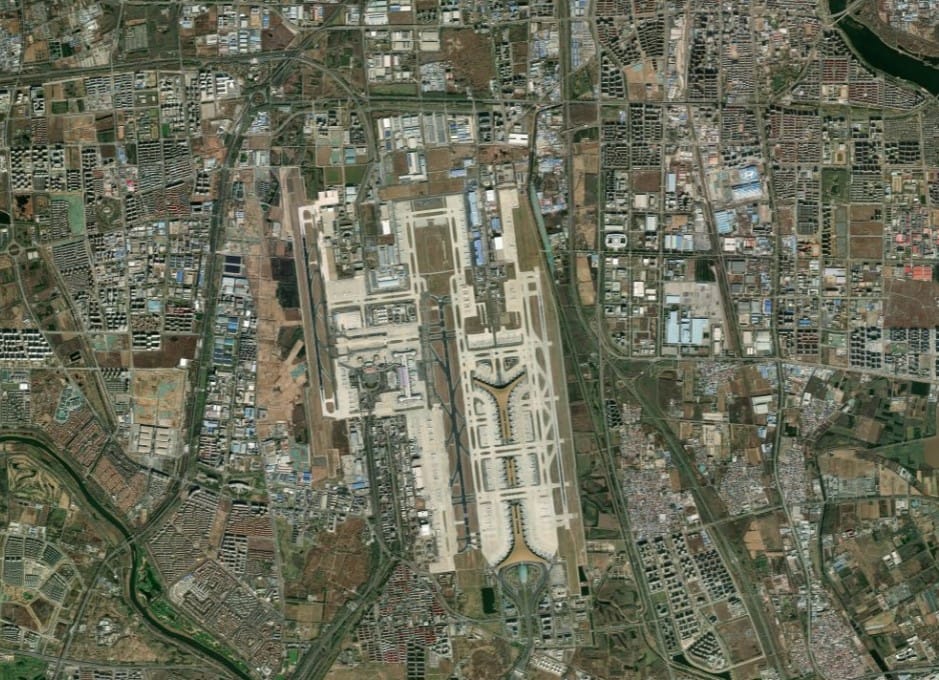
Daxing, covering 47 square kilometers south of Beijing, opened in 2019 with a genuinely striking starfish-shaped terminal designed by Zaha Hadid Architects the largest single-building airport terminal on the planet at roughly 700,000 square meters. The radial layout means no one walks more than 600 meters from security to a gate, which is remarkable given the building’s scale. Daxing set a fresh record of 50.08 million passengers in 2025, with around 70 airlines now flying to nearly 180 destinations from its gates.
- Location: Beijing, China
- Passengers (2025): 50,080,000
- Land area: 47 km² (18 sq mi)
Busiest Airports vs. Largest Airports: Why They’re Not the Same List
Here’s where things get interesting and, honestly, a bit counterintuitive. Size and traffic don’t line up the way you might assume. Hartsfield-Jackson Atlanta International Airport is the busiest airport on Earth by passenger count, yet it doesn’t appear anywhere on the land-area rankings above. Its footprint is efficient rather than sprawling, a testament to how well-designed runway spacing can move enormous crowds through a comparatively compact site.
According to Airports Council International’s 2026 dataset covering 2025 traffic, global passenger numbers reached roughly 9.8 billion, up 3.7% from 2024 and closing in on the symbolic 10-billion mark. Here’s how the ten busiest airports shaped up:
| Rank | Airport | 2025 Passengers |
|---|---|---|
| 1 | Hartsfield-Jackson Atlanta (ATL) | 106.3 million |
| 2 | Dubai International (DXB) | 95.2 million |
| 3 | Tokyo Haneda (HND) | 91.7 million |
| 4–10 | Includes DFW, Denver, Chicago O’Hare, London Heathrow, Shanghai Pudong, Istanbul, and Guangzhou Baiyun | 60–88 million range |
Shanghai Pudong deserves a special mention; it jumped from 10th to 5th place in a single year, a 10.7% surge tied to easing visa rules and rebounding international demand across the Asia-Pacific. Kuala Lumpur climbed six spots too, landing at 20th globally. If passenger volume is what interests you more than acreage, our companion piece on the busiest airports in the world breaks that ranking down in full.
Why Are Some Airports So Massive?
A few forces explain why the largest airports in the world got so big in the first place, and it’s rarely just “more passengers needed more room.”
- Cheap, flat land. Airports built in deserts (King Fahd) or open prairie (Denver) can acquire enormous tracts without displacing existing neighborhoods.
- Deliberate over-acquisition. Denver’s original master plan, for example, envisioned as many as 12 runways—well beyond what’s actually built today.
- Runway separation rules. Simultaneous parallel approaches typically require at least 1,310 meters of lateral separation, which eats up space fast once you add a third or fourth runway.
- Noise and safety buffers. Land surrounding runways often sits unused on purpose, absorbing noise and keeping communities at a safe distance.
- Military origins. King Fahd, Orlando, and Kansas City all started life as military airfields, which is why they inherited such generous footprints.