Dubai did not wait for nature to hand it more coastline. It built one. The artificial islands in Dubai now stretch across the Persian Gulf in shapes visible from space: palm trees, a seahorse, and even a rough map of the world. Some are finished and packed with hotels. Others sat half-built for over a decade before construction crews returned. This guide walks through every major artificial island in Dubai, what got built, what stalled, and what is happening on each one right now.
Artificial Islands in Dubai at a Glance
| Island / Development | Construction Started | Current Status | Key Highlight | Approx. Size |
|---|---|---|---|---|
| Palm Jumeirah | 2001 | Complete, fully operational | Atlantis The Palm, Nakheel Mall | 5.6 sq km |
| Palm Jebel Ali | 2002 | Revived in 2023, under construction | 7 connected islands, handovers from 2027 | Roughly 1.5x Palm Jumeirah |
| The World Islands | 2003 | Partially developed, some islands merging | Heart of Europe cluster | 9 km x 6 km lagoon |
| Dubai Islands (formerly Deira Islands) | Mid-2000s, relaunched in 2022 | Actively developing | 5 islands, 3 hotels open | 18.6 sq km |
| Bluewaters Island | 2013 | Complete | Ain Dubai observation wheel | 0.1 sq km |
| Jumeirah Bay Island | 2005 | Complete | Bulgari Resort Dubai | 0.5 sq km |
| Pearl Jumeirah | Mid-2010s | Mostly complete | Ultra-luxury villas | Small peninsula-island |
| La Mer / Port de La Mer | 2017 | Complete | Beachfront dining and marina | Coastal extension |
| Burj Al Arab Island | 1994 | Complete | Home to the Burj Al Arab hotel | 280m offshore |
(Insert screenshot here: a satellite or aerial map showing the layout of Dubai’s coast with each island labeled.)
Why Dubai Built So Many Artificial Islands
Land reclamation in Dubai was never just about scenery. The emirate has a short natural coastline, and once oil revenue started thinning out as a long-term bet, the government leaned hard into tourism and real estate instead. More coastline meant more beachfront property, and beachfront property sells at a premium almost anywhere in the world.
Nakheel, the state-backed developer, has been behind nearly every major artificial island in Dubai since the early 2000s. Its first and most famous project, Palm Jumeirah, was built near the Jumeirah coastal area of Dubai as one of three palm-shaped islands originally planned, alongside Palm Deira and Palm Jebel Ali. Palm Deira never kept its original palm shape. It got redesigned entirely and eventually became what is now called Dubai Islands.
Palm Jumeirah: The Original Artificial Island in Dubai
Palm Jumeirah remains the benchmark against which every other artificial island in Dubai gets measured. Construction began in 2001, and with a land area of over 1,380 acres, roughly 5.6 square kilometers, it ranks among the largest artificial islands in the world.
The layout is instantly recognizable. A central trunk branches into 17 fronds, all wrapped by an 11-kilometer crescent breakwater, with the whole structure spanning about 5 by 5 kilometers, an area equal to roughly 800 football fields. Divers who visit the surrounding waters sometimes stumble onto an unexpected attraction: sunken fighter jets that now serve as an artificial reef.
Palm Jumeirah today holds Atlantis The Palm, Nakheel Mall, The Pointe, and thousands of villas and apartments along the fronds. It is, by a wide margin, the most complete and most visited of Dubai’s artificial islands.
(Insert screenshot here: a photo of Palm Jumeirah’s crescent and fronds from ground level or drone footage)
Palm Jebel Ali: Dubai’s Long-Stalled Second Palm
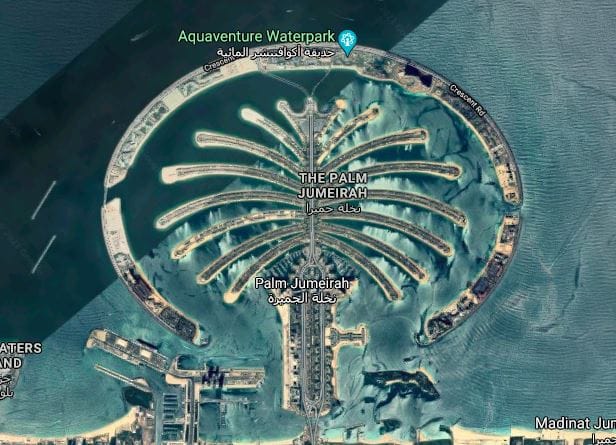
Palm Jebel Ali tells a messier story. Reclamation work moved fast at first, and by 2006 the project was reportedly 95 percent complete on major reclamation, with the surrounding breakwater about 98 percent finished. Then the 2008 financial crisis hit, and work paused in 2009 before three of the island’s fronds were ever finished.
For over a decade, satellite images showed an unfinished palm sitting quietly in the Gulf. That changed in 2023. Nakheel released a new masterplan in June 2023 for an island roughly double the size of Palm Jumeirah, with 110 kilometers of shoreline, more than 80 hotels and resorts, and seven connected islands designed for about 35,000 families. Sustainability got written into the plan too, with 30 percent of public facilities meant to run on renewable energy.
The revival has kept momentum since. Infrastructure contracts were awarded and construction resumed in May 2024, six international and local architects were appointed for villa design in January 2025, and further infrastructure contracts worth over AED 750 million followed in June 2025. Handovers are currently expected starting in 2027, though Nakheel has not confirmed a full completion date.
The World Islands: A Map That Never Quite Finished
The World is probably the most ambitious of Dubai’s artificial islands on paper and the least finished in practice. It consists of hundreds of small islands arranged to mimic a world map when viewed from above. Development has been uneven for years, with a handful of islands developed as private resorts, most notably the Heart of Europe cluster, while many others remain empty sand.
Recent contractor bids suggest Nakheel is rethinking the approach. Rather than developing 300 separate islets one by one, reclamation work is now underway to join individual islands together into continent-shaped landmasses, a change reportedly made to make the project easier to build out. Whether that speeds things up remains to be seen, but it marks a real shift from the original vision.
Dubai Islands: From Palm Deira to a Five-Island Destination
This is the project with the most name changes and arguably the most dramatic comeback. It started life as Palm Deira, got scrapped after the financial crisis, and was rebranded and scaled down as Deira Islands in October 2013, with plans for a night souk, mall, and residential towers. A bridge connecting the mainland to the islands opened in December 2016.
Then in 2022, Nakheel went further. The project was renamed Dubai Islands in 2022, with plans for roughly 80 hotels. The new master plan, released that August, described over 20 kilometers of beaches, including a Blue Flag-certified stretch, close to 2 square kilometers of parks and open space, and golf courses overlooking the Gulf.
The numbers involved are genuinely large. The Dubai Islands now spans 18.6 square kilometers across five interconnected islands, adding 57 kilometers of coastline, including 21 kilometers of beachfront, with a capacity for more than 231,000 residents across 49,000 homes. Hotels are already trickling in. The 800-key Hotel RIU Dubai opened in December 2020, the 607-key Centara Mirage Beach Resort followed in October 2021, and the 159-key Park Regis by Prince opened in March 2024. Infrastructure work keeps expanding too, with an AED 169 million contract awarded in October 2025 for roadworks and utilities at the Bay Villas area.
Bluewaters Island
Bluewaters sits just off Jumeirah Beach Residence and packs a lot into a small footprint. It is home to Ain Dubai, and it houses the world’s largest observation wheel, plus a mix of residential towers, restaurants, and a beachfront promenade. Unlike the older palm-shaped projects, Bluewaters went from groundbreaking to fully open in under a decade, which says something about how much faster Dubai builds now compared with the mid-2000s boom years.
Jumeirah Bay Island
Shaped like a seahorse when seen from above, Jumeirah Bay Island is smaller and far more exclusive than Palm Jumeirah. It is best known as the site of the Bulgari Resort Dubai, along with a limited number of ultra-high-end villas. There is no mall here, no theme park, just quiet, private beachfront living for people who want distance from the crowds on the bigger islands.
Pearl Jumeirah and La Mer
Pearl Jumeirah is a peninsula-island connected to the mainland near Jumeirah, built primarily for high-end villas and low-rise residential living. Next door, La Mer and its marina extension, Port de La Mer, turned a stretch of reclaimed coastline into one of Dubai’s more relaxed beach destinations, with open-air dining, retail, and water sports rather than skyscrapers.
Burj Al Arab Island
Long before Palm Jumeirah broke ground, Dubai had already tested the idea of building an entire island for one building. The Burj Al Arab Jumeirah, the world-famous luxury hotel, was built on its own artificial island roughly 280 meters offshore, connected to the mainland by a private curved bridge. In many ways, it was the proof of concept that made the later, far larger projects feel possible.
What Comes Next for Dubai’s Artificial Islands
A few things stand out looking across the full list. First, momentum has clearly returned. Palm Jebel Ali and Dubai Islands both sat dormant for years and are now moving again, backed by fresh contracts and firm timelines. Second, Nakheel appears to be learning from earlier mistakes. The shift toward joining World Islands into continents and the phased, contract-by-contract rollout on Palm Jebel Ali suggest a more cautious approach than the all-at-once ambition of the 2000s.
Whether every artificial island in Dubai on this list eventually gets finished is still an open question. Palm Jumeirah proves it can be done. The others are, for now, a mix of finished neighborhoods, active construction sites, and a few patches of reclaimed sand still waiting for their turn.
For more on Dubai’s place among the world’s most ambitious urban projects, see our coverage of the tallest buildings in the world and the largest artificial structures on Earth. If you are comparing the UAE against other fast-growing nations, our UAE country profile has the full picture.
For official updates straight from the source, check Nakheel’s project pages or Visit Dubai. Background on the earlier history of these projects is also well documented on Wikipedia’s Dubai Islands page and its Palm Islands page.