ITSM 4 has shifted its focus from enhancing technical expertise to focusing on customer experience. In the event of these rapid changes, businesses are more focused on enhancing customer experience. Offering the best customer experience has become a necessity for businesses for their survival. It should be a top priority for business organisations to stand out in market competition. According to the Gartner customer experience insights, customer experience has become a key differentiator for businesses seeking long-term growth and customer loyalty. Here is how ITIL Foundation helps organisations improve customer experience.
What is ITIL Foundation?
Before understanding how ITIL can improve customer experience, teams should first understand the ITIL framework. ITIL is a globally recognised framework for IT service management (ITSM) that provides best practices for designing, delivering, managing, and continually improving IT services. The official AXELOS ITIL framework explains how ITIL helps organisations align IT services with business goals while delivering value to customers.
Over the years, ITIL 4 Foundation has developed a clear process for managing service requests so that customers receive effective support on time. If you are a manager looking to improve customer experience through the ITIL framework, you should advance your IT career with ITIL 4 Foundation training.
ITIL practices that improve customer experience
Adopting ITIL guiding principles
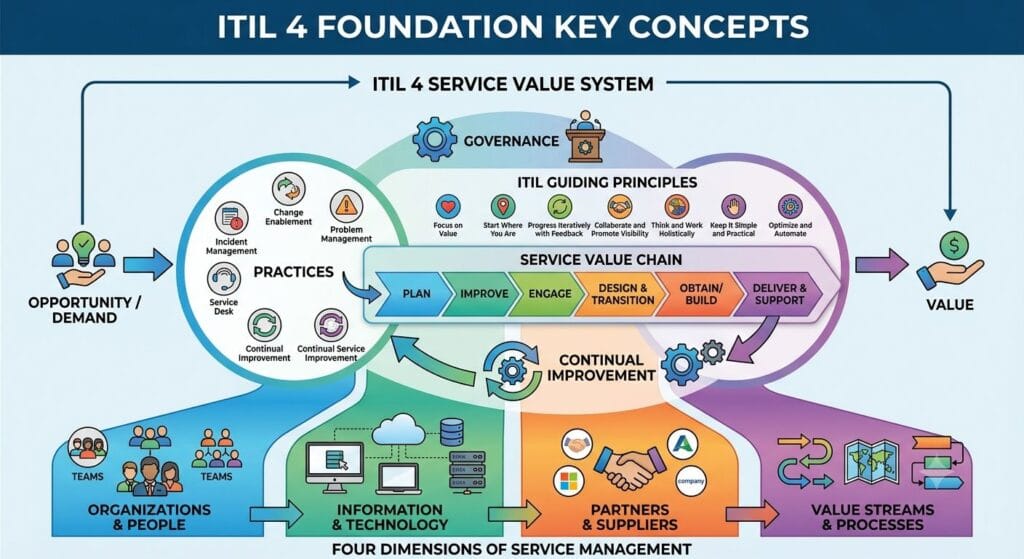
Organisations should learn the ITIL guiding principles to focus on delivering business value. These principles offer practical recommendations for delivering high-quality services that meet customer expectations. They also make it easier for organisations to adopt a customer-centric approach and consistently improve the customer experience. You can learn more about these principles on the official AXELOS website.
Implementing a service value chain approach
The ITIL 4 Foundation framework adopts the service value chain concept by integrating six core activities: Plan, Improve, Engage, Design & Transition, Obtain/Build, and Deliver & Support. These interconnected activities work together to create value for customers while ensuring that services remain aligned with changing business needs.
Continual improvement model
The ITIL framework offers simple and systematic steps for improving services at any scale. The continual improvement model helps teams understand the organisational vision, identify performance gaps, prioritise improvement opportunities, and implement changes that maximise customer value. The concept of continuous improvement is widely recognised across quality management practices, as explained by the American Society for Quality (ASQ).
How does ITIL Foundation help improve customer experience?
Understand customer needs before designing services
Many organisations make the mistake of assuming customer needs instead of asking customers directly. Businesses often design services believing they meet customer expectations, only to discover later that customers have different priorities. The ITIL Foundation framework encourages organisations to understand customer goals, expectations, and business requirements before designing or improving services. This customer-first approach leads to better service quality and higher satisfaction.
Customer interaction
The ITIL Foundation framework focuses on value creation through continuous customer engagement. It encourages organisations to interact regularly with customers, gather feedback, and understand changing business requirements before introducing new services or improvements. Instead of making assumptions, ITIL promotes value co-creation between service providers and customers. By continually assessing customer feedback, organisations can identify improvement opportunities and deliver services that better meet customer expectations.
Improve response time
Downtime is one of the biggest factors affecting customer satisfaction. Organisations can significantly improve response times by implementing structured incident and problem management processes. The IBM guide to IT Service Management (ITSM) explains how structured ITSM practices improve service reliability and operational efficiency.
Service reliability should not only be reflected in reports and performance metrics; customers should experience reliable service whenever they interact with the organisation. Even during unexpected service outages, customers should have confidence in the organisation’s ability to respond quickly and resolve issues efficiently. The structured ITIL framework enables organisations to identify, manage, and resolve incidents faster, minimising business disruption and improving customer satisfaction.
Continuous improvement based on customer feedback
Collecting customer feedback is one of the most effective ways to improve customer experience. Instead of viewing negative feedback as criticism, organisations should treat it as an opportunity for improvement.
The ITIL continual improvement model encourages organisations to analyse customer feedback, identify recurring issues, understand customer preferences, and implement meaningful improvements. This helps reduce recurring incidents while shortening both response and resolution times.
By continuously evaluating customer feedback, organisations can deliver services that are more efficient, reliable, and user-friendly. ITIL also recommends measuring key performance indicators such as customer satisfaction, service availability, first-contact resolution, and average resolution time to ensure improvements are delivering measurable business value.
What can organisations do to improve customer experience?
The organisation should travel along with the customers and understand their pain points to resolve them. They should ensure that their response times in fixing the issue exceed customer expectations. With the help of ITIL continuous improvement, organisations should assess the trends that will benefit customers and the organisation as well. The organisations should encourage and empower the teams to understand the ITIL customer-focused approach so that customer experience in the organisation will grow naturally.
Conclusion
Businesses should continuously evaluate customer feedback to understand customer pain points and resolve issues before they escalate. By implementing the ITIL 4 Foundation framework, organisations can proactively identify service issues, prioritise them according to business impact, and resolve them efficiently.
Through structured service management, continual improvement, and customer-focused practices, the ITIL framework enables organisations to deliver reliable services, improve customer satisfaction, and build stronger long-term customer relationships.