Asia sits on huge crude reserves and processes even more of the stuff than it pumps. The largest oil refineries in Asia turn Middle Eastern crude into petrol, diesel, jet fuel, and petrochemical feedstock for billions of people. India, China, South Korea, and Japan buy most of that crude, and they refine it at a scale few other regions can match. Below you’ll find the biggest sites ranked by capacity, who runs them, and why they matter far beyond their home countries.
Capacity figures are approximate and shift as operators debottleneck units or add new trains. Treat them as ballpark numbers.
| Rank | Refinery | Country | Operator | Approx. Capacity (barrels per day) |
|---|---|---|---|---|
| 1 | Jamnagar Refinery Complex | India | Reliance Industries | 1,400,000 |
| 2 | Ruwais Refinery | UAE | ADNOC | 920,000 |
| 3 | SK Energy Ulsan Refinery | South Korea | SK Energy | 840,000 |
| 4 | Zhejiang Petrochemical (Zhoushan) | China | ZPC | 800,000 |
| 5 | GS Caltex Yeosu Refinery | South Korea | GS Caltex | 800,000 |
| 6 | S-Oil Onsan Refinery | South Korea | S-Oil | 670,000 |
| 7 | Al-Zour Refinery | Kuwait | KIPIC | 615,000 |
| 8 | Jurong Island Refinery | Singapore | ExxonMobil | 590,000 |
| 9 | Ras Tanura Refinery | Saudi Arabia | Saudi Aramco | 550,000 |
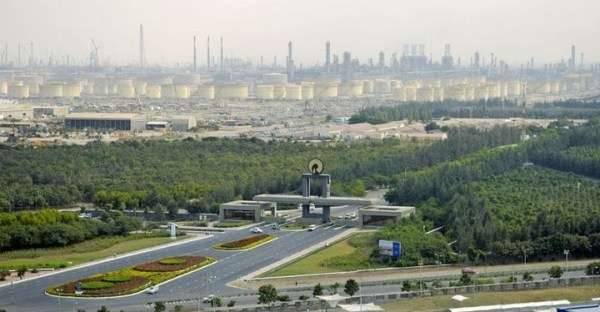
Why Asia Dominates Global Refining
Geography explains a lot. Crude flows east from the Gulf along short, cheap tanker routes, so refiners in Asia sit right next to the cargoes they need. Demand does the rest. Factories, highways, airports, and petrochemical plants keep growing, and local governments would rather import crude and make fuel at home than buy finished products abroad.
That logic has pushed countries to build very large, very complex plants. Many of them run hundreds of thousands of barrels a day. A few exceed a million.
You can see the upstream side of this story in our guide to the largest oil-producing countries and the demand side in our ranking of the biggest oil-consuming countries. For official production and consumption data, the U.S. Energy Information Administration is a reliable starting point.
Top Refineries Profiled
1. Jamnagar Refinery Complex, India
Jamnagar is the heavyweight. Located in Gujarat on India’s western coast, this Reliance Industries complex handles roughly 1.4 million barrels per day, which makes it the largest refining site on the planet, not just in Asia.
What sets it apart isn’t only size. The plant is built to digest heavy, sour, and cheaper crudes that simpler refineries struggle with, then convert them into higher-value fuels. That flexibility lets Reliance shop around for bargains on the crude market. It also exports a large share of its output to Europe, Africa, and other parts of Asia.
- Operator: Reliance Industries
- Location: Jamnagar, Gujarat
- Approx. capacity: 1.4 million barrels per day
- Main outputs: gasoline, diesel, jet fuel, petrochemical feedstock
2. Ruwais Refinery, United Arab Emirates
Ruwais, run by ADNOC in Abu Dhabi, processes somewhere around 900,000 barrels a day after its latest expansion. It sits close to the fields that feed it, so logistics are about as short as they get. The site supplies both domestic demand and export markets, and it is tied into a large adjacent petrochemical hub.
- Operator: ADNOC
- Approx. capacity: about 920,000 barrels per day
3. SK Energy Ulsan Refinery, South Korea
Ulsan is South Korea’s flagship. SK Energy’s complex runs near 840,000 barrels per day and links directly to petrochemical and lubricant units on the same industrial campus. Because the plant feeds so many downstream operations, it behaves less like a lone refinery and more like the engine of a small industrial city.
South Korea has no domestic crude to speak of. Everything arrives by tanker, mostly from the Middle East, which makes plants like this a quiet pillar of national energy security.
- Operator: SK Energy
- Approx. capacity: about 840,000 barrels per day
4. Zhejiang Petrochemical, Zhoushan, China
China’s newer mega-refineries changed the rankings in under a decade. The Zhoushan site, built in phases on an island off Zhejiang province, now sits near 800,000 barrels per day and ties crude refining tightly to chemical output. Other major Chinese plants, including facilities run by Sinopec and PetroChina, add to the country’s total, which ranks among the highest worldwide.
For the wider picture of the country’s energy footprint, see our page on China’s energy statistics.
- Operator: Zhejiang Petrochemical (ZPC)
- Approx. capacity: about 800,000 barrels per day
5. GS Caltex Yeosu Refinery, South Korea
Yeosu rivals Ulsan in scale at roughly 800,000 barrels per day. GS Caltex built a reputation here for deep conversion units that squeeze more diesel and gasoline out of each barrel. Output goes to Korean drivers and also to buyers across the Pacific.
- Operator: GS Caltex
- Approx. capacity: about 800,000 barrels per day
6. S-Oil Onsan Refinery, South Korea
South Korea is the only country with three entries on this list, and Onsan is the third. S-Oil, partly owned by Saudi Aramco, runs close to 670,000 barrels a day there. That ownership link shows how Gulf producers lock in demand by buying into refiners downstream.
7. Al-Zour Refinery, Kuwait
Al-Zour came online relatively recently and handles about 615,000 barrels per day. Kuwait built it to upgrade its crude into cleaner, higher-value products rather than shipping raw barrels alone.
8. Jurong Island Refinery, Singapore
Singapore is tiny, but its refineries are not. ExxonMobil’s Jurong Island plant processes around 590,000 barrels per day, and the city-state serves as Asia’s main trading and bunkering hub. Much of its fuel never touches Singapore’s own roads. It moves on to Indonesia, Malaysia, Australia, and beyond.
9. Ras Tanura Refinery, Saudi Arabia
Ras Tanura handles about 550,000 barrels per day and sits beside one of the world’s biggest oil export terminals. Saudi Arabia runs several other large plants too, including Yanbu and Jubail, so the kingdom contributes heavily to the region’s refined product supply.
10. Japan and the Rest of Asia
Japan doesn’t place any single site in the top nine, yet it still matters. Its refiners, ENEOS above all, operate many mid-sized plants that together supply one of the world’s most fuel-hungry economies. The country leans on imported Middle Eastern crude for nearly all of it, so its refining fleet is built for reliability rather than record-breaking size.
Across Southeast and South Asia, newer projects keep appearing. India has several large plants beyond Jamnagar, including Nayara’s Vadinar site, and Vietnam and Malaysia keep adding capacity. The ranking will probably look different within a few years.
How These Refineries Shape Trade
Big refineries do two jobs at once. They keep home fuel markets supplied, and they sell surplus gasoline, diesel, and jet fuel to the rest of the world. That second role makes Asia a net exporter of some products even while it imports almost all of its crude.
Three things drive the trade flows:
- Crude access. Plants near Gulf supply routes buy cheaper and ship faster.
- Complexity. Refineries that handle heavy crude earn better margins.
- Petrochemical integration. Sites linked to chemical plants capture value beyond fuel.
For global context on supply chains and refining capacity trends, the International Energy Agency publishes regular analysis, and OPEC’s annual statistical bulletin covers refinery capacity by region.