
“In this world, nothing can be said to be certain, except death and taxes.” – Benjamin Franklin
Benjamin Franklin once said that nothing is certain except death and taxes, and honestly, most of us in India feel that truth every single March. But here’s the thing: income tax saving in India isn’t about dodging the system, it’s about using the provisions Parliament has already built into the law. Whether you’re a salaried employee comparing regimes for the first time or someone who has filed returns for a decade, this guide walks through what actually works in FY 2026-27, and what has quietly changed.
Old Regime vs New Regime: A Quick Comparison
Since the new tax regime became the default under Section 115BAC, most income tax-saving conversations start with one question: Which regime should you pick? Here’s a side-by-side look to make that decision easier.
| Feature | New Tax Regime (Default) | Old Tax Regime |
|---|---|---|
| Basic exemption limit | Rs. 4 lakh | Rs. 2.5 lakh (below 60 years) |
| Section 87A rebate | Up to Rs. 60,000 (income up to Rs. 12 lakh) | Up to Rs. 12,500 (income up to Rs. 5 lakh) |
| Standard deduction (salaried) | Rs. 75,000 | Rs. 50,000 |
| Section 80C deduction | Not available | Up to Rs. 1.5 lakh |
| Section 80D (health insurance) | Not available | Available |
| Home loan interest (Section 24b) | Only for let-out property | Available up to Rs. 2 lakh (self-occupied) |
| NPS employer contribution (80CCD(2)) | Available | Available |
| Effective tax-free income (salaried) | Up to Rs. 12.75 lakh | Depends on deductions claimed |
As this table suggests, the new regime rewards simplicity, while the old regime rewards people who are disciplined about investing and have documented deductions to claim. There isn’t a universal right answer here; it genuinely depends on your salary structure and investment habits. old vs New tax regime calculator.
Understanding Income Tax in the Current Landscape
Income Tax is a direct tax the government levies on what individuals, companies, and other entities earn in a financial year. It can feel like an overwhelming burden, particularly when you’re staring at a payslip that’s thinner than expected. However, the Indian tax system, even after being reorganised under the Income Tax Act, 2025, still offers legitimate routes to bring your liability down. The trick is knowing which route applies to your regime.
It’s worth noting that the new tax regime remains the default option unless you actively opt out through Form 10-IEA (for those with business income) or simply choose the old regime while filing your return (for salaried individuals, this choice can be made every year). Therefore, the very first income tax saving decision you make each year is really about regime selection, not investment selection.
1. Making the Most of Section 80C (Old Regime Only)
If you’ve opted for the old regime, Section 80C is likely to appear to be the workhorse of your income tax saving plan. It permits deductions up to Rs. 1.5 lakh across several instruments:
- Employee Provident Fund (EPF): A portion of your salary is withheld and invested automatically for retirement, and these contributions qualify for deduction.
- Public Provident Fund (PPF): A long-term, government-backed scheme where both the contribution and the interest earned are tax-free, making it a genuinely EEE (Exempt-Exempt-Exempt) instrument.
- Equity-Linked Savings Schemes (ELSS): These mutual funds invest predominantly in equities and, moreover, carry the shortest lock-in period among 80C options at just three years.
- Tax-Saving Fixed Deposits: These come with a five-year lock-in, and while the principal qualifies for deduction, the interest earned is still taxable.
- National Savings Certificates (NSC): A fixed-income government scheme where the interest, though taxable, can be reinvested and claimed again under 80C.
A word of caution though: cramming all Rs 1.5 lakh into low-yield instruments just to save tax may not always serve your long-term wealth goals. It’s often better to think of 80C as a shopping basket, not a single product.
2. Unlocking Home Loan Benefits
A home loan appears to offer one of the more substantial income tax saving opportunities available to old-regime taxpayers, but the exact benefit depends on how the property is used.
| Loan component | Deduction available | Applicable section | Regime |
|---|---|---|---|
| Interest, self-occupied property | Up to Rs. 2 lakh/year | Section 24(b) | Old only |
| Interest, let-out property | No upper limit | Section 24(b) | Old and New |
| Principal repayment | Within overall Rs. 1.5 lakh cap | Section 80C | Old only |
| First-time homebuyer add-on | Up to Rs. 50,000 | Section 80EE | Old only |
Joint borrowers can each claim these deductions individually against their own share of ownership and EMI, which effectively doubles the household’s tax advantage.
Tools to implement this: Most lenders (SBI, HDFC, ICICI) issue an annual interest certificate through their net banking portal or mobile app under “Statements & Certificates,” which is the document you’ll actually need while filing. The Income Tax Department’s tax calculator also lets you plug in the interest and principal figures to see the regime-wise impact instantly.
3. Buying a Health Insurance Policy
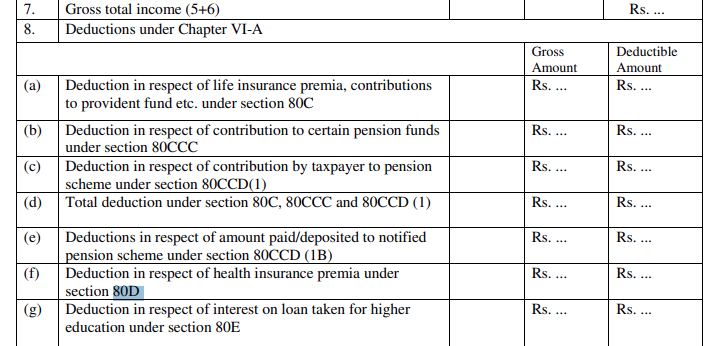
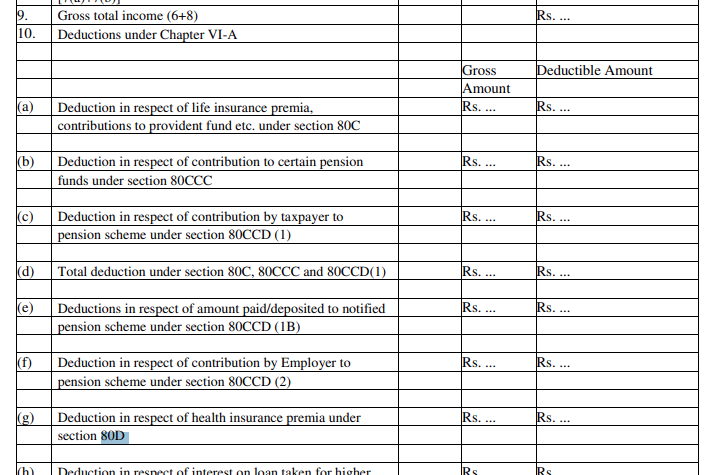
Health insurance premiums remain deductible under Section 80D, but only for those in the old regime.
| Covered for | Maximum deduction |
|---|---|
| Self, spouse, children | Rs. 25,000 |
| Parents (below 60) | Additional Rs. 25,000 |
| Parents (60 and above) | Additional Rs. 50,000 |
| Preventive health check-up | Included within above limits, up to Rs. 5,000 |
Beyond the tax angle, a health insurance policy genuinely protects your savings from being wiped out by a medical emergency, so this is one of those deductions that’s worth claiming regardless of which regime debate you’re having with yourself.
Tools to implement this: Insurer apps such as Star Health, HDFC Ergo, or Care Health generate a downloadable premium payment certificate that shows the exact 80D-eligible amount each renewal cycle, which is the document you’ll attach or reference while filing.
4. Interest on Savings Accounts
Sections 80TTA and 80TTB allow a deduction on interest earned from savings accounts, though the ceiling changes with age.
- Below 60 years (Section 80TTA): Deduction capped at Rs. 10,000 on savings account interest only.
- 60 years and above (Section 80TTB): Deduction capped at Rs. 50,000, and this extends to fixed deposit and recurring deposit interest too.
Again, these benefits apply only under the old regime.
Tools to implement this: Your bank’s net banking dashboard (SBI YONO, HDFC NetBanking, ICICI iMobile, and most others) has an “Interest Certificate” section that gives you the exact interest figure for the financial year, which you’ll need while computing this deduction.
5. Life Insurance Premiums
Premiums paid toward life insurance policies qualify for deduction under Section 80C, capped at Rs. 1.5 lakh combined with your other 80C investments. Furthermore, under Section 10(10D), maturity proceeds or death benefits from the policy are generally tax-free, provided the premium doesn’t exceed 10% of the sum assured, for policies issued after April 2012.
This dual benefit, protection plus tax relief, is why life insurance is frequently bundled into income tax saving discussions, even though its primary purpose should always be financial protection for dependents, not investment returns.
Tools to implement this: Insurers like LIC, Max Life, and HDFC Life let policyholders download a “Premium Paid Certificate” directly from their customer portal or app, which is the document you’ll need for your 80C claim.
6. NRE Account Interest
For Non-Resident Indians, interest earned on NRE (Non-Resident External) accounts continues to be exempt from Indian income tax, regardless of which regime applies, since NRIs typically don’t choose between the two the same way resident taxpayers do. This makes NRE accounts a genuinely tax-efficient parking spot for overseas earnings.
Tools to implement this: Banks with strong NRI banking apps, such as ICICI NRI Services or HDFC Bank NRI Banking, let you open and monitor NRE accounts entirely online, along with generating the interest certificates your foreign tax filings might separately require.
7. Education Loan Interest
Section 80E permits an uncapped deduction on interest paid toward an education loan, for up to eight years or until the interest is fully repaid, whichever happens first. There’s no ceiling on the deduction amount, which makes this one of the more generous, if underused, income tax saving provisions in the old regime.
Tools to implement this: Lenders like HDFC Credila and Avanse provide a loan account statement through their borrower portal, breaking out principal and interest separately, since only the interest component is deductible here.
8. Charitable Donations
Donations to eligible charities and institutions are deductible under Section 80G, with the deductible percentage, 50% or 100%, depending on the specific fund or institution.
| Donation type | Typical deduction |
|---|---|
| PM National Relief Fund and similar notified funds | 100%, no qualifying limit |
| Most registered charitable trusts (80G approved) | 50%, subject to a qualifying limit |
| Donations in cash above Rs. 2,000 | Not eligible for deduction |
Do keep the receipt and the trust’s 80G registration number handy, since the deduction is often disallowed at the assessment stage if documentation is missing.
Tools to implement this: The Income Tax Department’s e-filing portal lets you verify a trust’s 80G registration validity under “Tax Exempted Institutions” before you donate, which is worth doing once rather than discovering the claim was invalid later.
9. NPS Contributions: The New Regime’s Best Friend
If you’ve moved to the new tax regime, don’t assume all deductions are gone. Employer contributions to the National Pension System under Section 80CCD(2) remain available in both regimes, and this is arguably one of the most efficient tools left for salaried employees.
- Ask your HR or payroll team whether the company offers NPS as part of the flexible benefits or CTC restructuring option.
- Once enrolled, contributions and returns can be tracked through the NPS by the NSDL or CRA e-NPS portal and app.
- Employees can typically request their employer restructure a part of the salary as an NPS contribution, which lowers taxable income without touching take-home pay drastically.
Tools to implement this: The e-NPS portal allows both account opening and ongoing contribution tracking, and most payroll systems (Darwinbox, Zoho Payroll, GreytHR) now include an NPS declaration option directly in the employee self-service dashboard.